
Reviewed · SELF-GUIDED TOURS
Bath Self-Guided Private Tour
Bath teaches history at walking pace. This self-guided tour strings together Roman Bath, Bath Abbey, and the city’s best Georgian streets, with Helen’s live-sounding audio guiding you block by block. You get a GPS route and map so you always know where to go next, not just what to read.
What I like most is how practical the plan feels once you are on the ground. I love that you can pick your own stops for breaks and photos, because you are not tied to a group schedule. I also like that the app gives you audio, photos and visuals, so you are not guessing what you are looking at.
One thing to consider: this is app-dependent, so if you have trouble activating the tour email or your phone audio glitches, your experience can stall. I recommend charging your phone fully before you start and allowing time to test your headphones.
In This Review
- Key highlights to look for on this Bath route
- Starting at Abbey Chambers, then walking Bath like a private group
- How Helen’s audio guide turns Bath’s buildings into a story
- Roman Bath and Bath Abbey: the two anchors that make everything click
- Kingston Parade and York Street: an easy start with big views
- Sally Lunn’s Museum and North Parade Passage: pre-Georgian textures in a Georgian city
- Parade Gardens by the River Avon: the pause that improves the walk
- Pulteney Bridge and the engineering trick you will want to spot
- Great Pulteney Street: the wide pavements that change how you move
- Henrietta Park: the quiet detour that keeps the walk from feeling rushed
- Holburne Museum and Upper Borough Walls: where the walk gets more textured
- The Circus and Royal Crescent: Georgian architecture in its show-off mode
- Gay Street, Royal Victoria Park, Queen Square, and Theatre Royal
- Ending at Thermae Bath Spa and crossing over into the spa area
- Value at about $12.33 per person: when a self-guided route makes sense
- Who should book this Bath self-guided private tour
- Should you book it?
- FAQ
- Is there an in-person guide?
- How long does the Bath self-guided walk take?
- Where do I start and where do I end?
- How do I activate the tour in the app?
- Can I use the tour more than once?
- Are any stops free to visit?
Key highlights to look for on this Bath route
- Aquae Sulis to Bath Abbey: Roman-era context that helps everything make sense later
- Georgian wow factor in tight stretches: Circus, Royal Crescent, Queen Square, and more
- Pulteney Bridge shopfront drama: shops across the bridge span is a real talking point
- Fresh air between buildings: Parade Gardens, Royal Victoria Park, and Henrietta Park
- Low-cost pacing: you are free to slow down at the parks without paying for a tour group
- An ending with options: your walk finishes at Thermae Bath Spa, where you can keep exploring
Starting at Abbey Chambers, then walking Bath like a private group
You begin at Abbey Chambers, Church St, Avon, Bath BA1 1LZ. That location is a smart launching pad because it puts you near the center of historic Bath right away, instead of starting out on the outskirts and then playing catch-up.
This is listed as a private tour/activity, so it is only your group using the app. Even though it is self-guided, that matters. You can move at your pace, linger where you want, and avoid the feeling of having to “keep up” with strangers.
You have 3 weeks of unlimited access to the tour in the app. So if you start one day and then want to come back for one street you loved, you can. The tour is also in English, and the route is described with a map, directions, and a GPS route with stops.
Fitness-wise, the tour suggests moderate physical fitness. In plain terms: it is a walk through a compact historic center with multiple short stops, not a bus-and-museum loop.
Also on in Bath, no fuss
How Helen’s audio guide turns Bath’s buildings into a story
The headliner feature here is the audio. You get Helen guiding you through the route with an audio guide that is not computer-generated voice. That sounds like a small detail until you are ten minutes into a walk and you realize you are actually listening, not just trying to read tiny screen text while you walk.
I like this setup because it changes how you look at the city. Bath is full of “pretty stone facades,” but the audio helps you connect those facades to names, dates, and why certain places matter. You are not just ticking boxes. You are learning what to notice, like the bridge design, the layout of the squares, and the Georgian planning behind the streets.
You are also given videos, pictures, and recommendations in the app. People who have used it well often mention the tour helped them find good places to eat and drink without turning Bath into a checklist. That kind of guidance is worth real money when you are on foot and decisions are constant.
Practical tip: since it is an app experience, bring a fully charged phone. If you want photos, dim your screen a bit. And keep headphones ready, because a few people have reported audio playback issues when they were trying to run the tour on the fly.
Roman Bath and Bath Abbey: the two anchors that make everything click
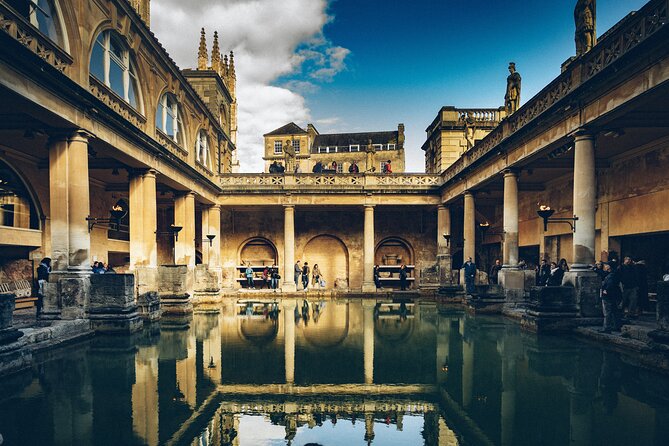
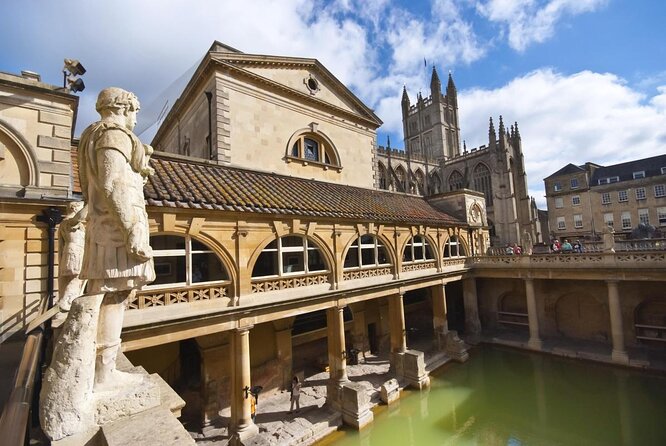
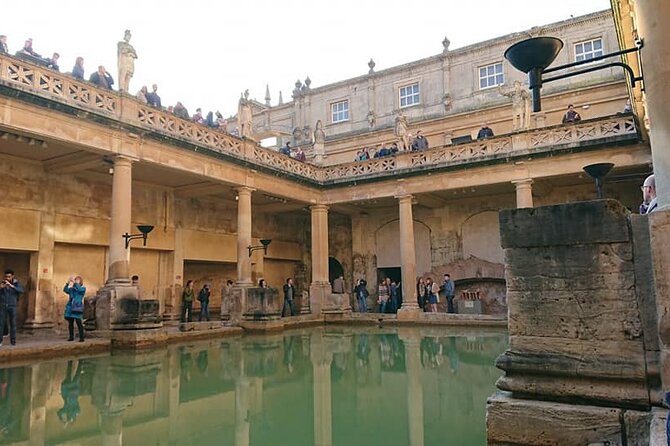
Your route starts by placing you in the Roman layer of Bath. The city’s original name is Aquae Sulis, and it is thought to have been occupied from around 43AD. The Roman Baths are described as a Grade I listed building and a Scheduled Monument. That is not trivia. It is a reminder that you are walking in a place where major eras overlap.
Next comes Bath Abbey, often viewed as the city center. It is one of Bath’s most visited attractions in the Southwest, and the tour uses it as a reference point so the rest of your walk feels connected, not random.
From there, you move toward the streets and spaces that show Bath’s later power and wealth, especially in the Georgian era.
Kingston Parade and York Street: an easy start with big views
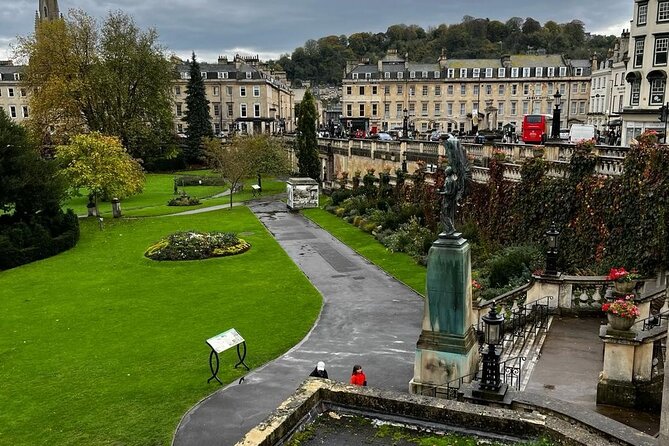
One of the nice early transitions is York Street. The walk from the Abbey courtyard toward York Street takes you through Kingston Parade, which is more of a square than a promenade even though the name suggests otherwise.
The payoff is views. From here you get a sense of the city’s scale and how the major landmarks relate to each other, including sightlines toward the cathedral and the Roman Baths area.
Even if you do not go inside immediately, this stop works because it helps you orient your eyes. Bath is a city where angles matter.
Sally Lunn’s Museum and North Parade Passage: pre-Georgian textures in a Georgian city
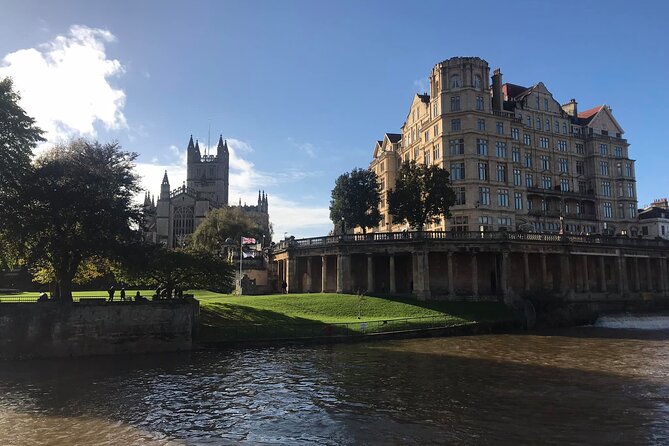
Then you hit Sally Lunn’s Museum on North Parade Passage, which used to be called Old Lilliput Lane. This is one of the tour stops that makes Bath feel layered instead of overly polished.
The tour notes that most of the timber-framed houses were rebuilt over the centuries. What is special here is that Sally Lunn’s at number 4 still has its timber-framework. That means you are seeing older building fabric, not just later updates.
Why I like this stop on a walking tour: it gives your brain a contrast. After Roman and Abbey context, you need a quick reminder that Bath was lived in, not just designed for postcards.
While the kettle’s on in Bath:
- Walking Tour of Bath with Blue Badge Tourist Guide★ 5.0 · 1,877 reviews
- Stonehenge, Avebury & the Cotswolds from Bath (Small group)★ 5.0 · 798 reviews
- Roman Baths and Bath City Walking Tour★ 4.5 · 762 reviews
- Fully Guided Bath Ghost Tours★ 5.0 · 539 reviews
Parade Gardens by the River Avon: the pause that improves the walk
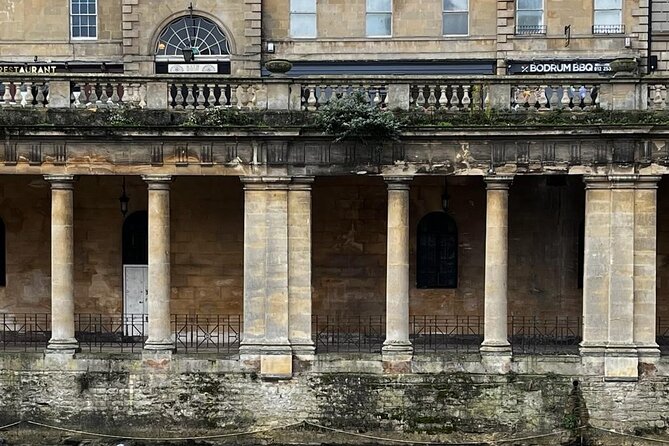
Next is Parade Gardens, a two-and-a-half-acre green space beside the River Avon. It dates back to 1709 and is listed as a Grade II park.
This is where you can slow down. If your phone battery is draining, this is a good moment to put it in low power and actually look around. A garden stop also breaks up the city density, so when you start seeing bridges and major streets again, you feel fresher.
Pulteney Bridge and the engineering trick you will want to spot
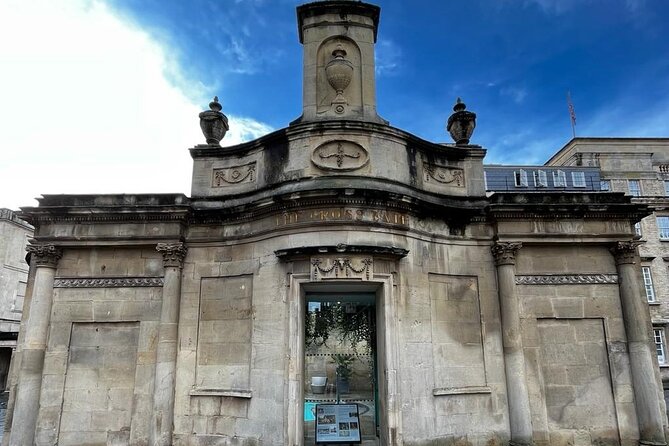
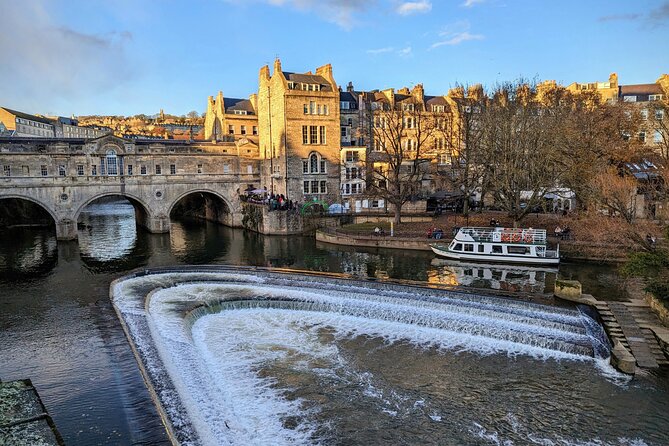
Pulteney Bridge is one of those Bath features that sounds too neat to be real until you see it. The tour explains it is believed to be one of only four bridges worldwide that has shops across the full span on both sides.
That shopfront layout matters. It makes the bridge feel like an active street rather than a crossing. When you walk, you start looking not just at the bridge itself, but at how the commerce lines up with the river view.
Right after, Pulteney Weir adds the water-power layer. It first appeared on Bath maps in 1603, and it was originally built to power two corn mills on both sides of the river. If you are a details person, this is where you appreciate why Bath developed where it did.
Great Pulteney Street: the wide pavements that change how you move
You will also pass Great Pulteney Street, described as the widest and grandest thoroughfare in Bath. The plan is part of the Georgian idea: wide pavements, and in some places those pavements are as wide as the road itself.
I find this stop useful even if you do not sit down. Wider sidewalks mean you can take photos without stepping into traffic, and you can compare streetscapes as you walk from one landmark to the next.
Henrietta Park: the quiet detour that keeps the walk from feeling rushed
A little off the main tourist flow is Henrietta Park, a seven-acre park that opened in 1897 to celebrate the Diamond Jubilee of Queen Victoria.
This is a solid pick for a break. It gives your legs and your eyes a rest. It also helps the walking tour feel human, because it is not all architecture trophies back to back.
If you are doing this with kids or with anyone who needs short breaks, Henrietta Park is likely to be one of the best moments of the route.
Holburne Museum and Upper Borough Walls: where the walk gets more textured
The route includes a stop at the Holburne Museum, which houses items previously owned by Sir William Holburne. The tour notes he inherited a modest fortune and spent some of it travelling Europe. That context turns a museum stop into a story about collecting and travel, not just a building you pass.
Then you come to Upper Borough Walls, named for the site of the original medieval town wall of Bath. Many houses along the road are also listed, so you get a sense of how the city expanded and layered itself over older boundaries.
If you like history that shows up in street shapes and building edges, this is a stop worth paying attention to.
The Circus and Royal Crescent: Georgian architecture in its show-off mode
Now the route pivots into Bath’s most famous Georgian set pieces.
The Circus is described as one of the best places to see Georgian architecture. It was originally called the King’s Circus. Even if you are not an architecture nerd, you will feel the symmetry and the intentional curve as you walk around it.
Next is No. 1 Royal Crescent, with construction dated 1767 to 1775. The tour highlights 30 grade I listed houses there, plus it points out that Bath also has other Georgian crescents like Lansdown Crescent and Somerset Place.
This part of Bath can overwhelm people if they rush. So here is my advice: do one slow loop of The Circus and one slow look at the Royal Crescent frontage. If you try to sprint, you miss why these spaces are so iconic.
Gay Street, Royal Victoria Park, Queen Square, and Theatre Royal
You will also pass Gay Street, part of the Circus development. It connects to the work of John Wood the Elder, completed by John Wood the Younger after his father’s death. The tour also notes houses along the stretch are Grade I or II listed.
Then it is Royal Victoria Park, opened in 1830 by Princess Victoria, who was 11 years old at the time and would later become queen. That detail is the kind you remember, because it makes the park feel like a decision made by a young person, not an anonymous commission.
After that comes Queen Square, a one-acre communal garden surrounded by Grade I listed buildings. It is dedicated to Queen Caroline, wife of George II.
Finally, you reach Theatre Royal Bath, a Georgian building constructed in 1805 and refurbished in 2010. It is described as one of the oldest and arguably most attractive theatres in the country.
If you are the type who likes to photograph doors, windows, and the rhythm of masonry, this section gives you multiple angles without forcing you to enter every building. You can keep moving while still feeling like you covered major culture stops.
Ending at Thermae Bath Spa and crossing over into the spa area
Your tour ends at Thermae Bath Spa, The Hetling Pump Room, Hot Bath St, Bath BA1 1SJ. The tour guide information says this is the end point, and you will be free to wander around Thermae Bath and the Cross Bath afterward.
The tour explains Thermae Bath Spa was built on the site of the former Beau Street swimming baths, and it opened in 2006. It is heated using naturally thermal waters of the Minerva Bath.
Even if you do not go fully inside, ending here gives your walk a payoff you can feel immediately. After hours of stone and squares, the spa setting brings Bath into a different mood.
My practical suggestion: if you are planning to spend time inside, consider doing that right after your audio finishes while you are still in “history mode.”
Value at about $12.33 per person: when a self-guided route makes sense
At $12.33 per person, the value depends on how you tour.
If you like to walk independently, this is an easy number to justify. You get GPS route guidance, a full audio narrative by Helen, and the ability to revisit the content within your 3 weeks of access. You also get photos, videos, and recommendations, plus a private feel since it is only your group using the app.
If you prefer someone standing next to you answering questions in real time, this is not the best fit because it is explicitly self-guided. And because it is app-based, the experience can be less smooth if the phone part fails, such as missing your activation email or having app audio playback problems.
But if you are comfortable using your phone as your guide, the cost is low for a route that covers a lot of Bath’s key landmarks in a compact walk.
One more note from real-world use: people tend to love the freedom. They like starting and stopping for snacks and coffee without negotiating with a group. If that sounds like your travel style, you will probably enjoy this.
Who should book this Bath self-guided private tour
This tour fits you best if:
- You like walking at your own pace and want control over how long you stay at each stop
- You value audio narration and want clear guidance without a live guide
- You want a route that connects Roman context to Georgian architecture, not just isolated photo spots
- Your group includes people who want different break times, because you are not stuck in a big crowd
I would skip it if:
- You know your phone often struggles with app playback or you hate relying on activation emails
- You want deep, on-the-spot answers that only a person can give
Should you book it?
Yes, if you want a simple, well-paced Bath walk powered by Helen’s audio and supported by GPS. The route covers the Roman anchors, Bath Abbey, and the big Georgian hitters, then lands you at Thermae Bath Spa with a satisfying ending.
If you book, do two smart things first: charge your phone and activate the tour using the email instructions before you set out. That one step can make the difference between a smooth afternoon and a frustrating restart.
If you are the type who enjoys architecture, parks, and city details, this is a good use of time at a low price.
FAQ
Is there an in-person guide?
No. This is a self-guided tour using an app. The guidance comes from Helen’s audio guide in English.
How long does the Bath self-guided walk take?
The route is listed as about 2 to 3 hours.
Where do I start and where do I end?
You start at Abbey Chambers, Church St, Avon, Bath BA1 1LZ, UK. You end at Thermae Bath Spa, The Hetling Pump Room, Hot Bath St, Bath BA1 1SJ, UK.
How do I activate the tour in the app?
You receive an email with instructions to activate the tour. The information notes that the booking reference is not the code.
Can I use the tour more than once?
Yes. You get 3 weeks unlimited access to the self-guided tour on the app.
Are any stops free to visit?
Several stops in the route are marked as Admission Ticket Free, including places like Parade Gardens, Pulteney Bridge, Henrietta Park, Queen Square, and The Theatre Royal Bath.
Latest to join the queue for Bath






Self-Guided Tours, compared.


Golden Tours York Hop-on Hop-off Open Top Bus Tour with Audio Guide
Read our review →
Windsor Castle Tour from London with Transportation & Audio Guide
Read our review →
London Panoramic Open Top Bus Tour with Audio Guide
Read our review →
Romans, Vikings and Medieval York: An Audio Tour
Read our review →
Emirates Stadium and Arsenal Museum Entrance Ticket Including Audio Guide
Read our review →
Private Self-Guided Dinky Door Hunt in Cambridge
Read our review →
Natural History Museum Express Guided Tour & Audio Guide
Read our review →Browse the lists this tour appears in