

Reviewed · SELF-GUIDED TOURS
Private Chester Self-Guided Tour
Chester rewards slow walking, even with a phone in hand. This self-guided audio tour gives you a clean route through the city’s big-name sights and some Roman leftovers, with GPS support so you are not guessing street corners. You can take it at your pace, pause when you want photos, and keep moving when you do not.
I especially like the structured flow for the price. It turns Chester into a “go here, look there, understand this” walk, instead of a vague sightseeing list. I also like that the audio is described as being guided by Jake, plus you get photos, videos, and recommendations to help you make sense of what you see.
One possible drawback: since this is app-based, you might hit the usual tech friction. Some users have flagged playback or direction issues, so I recommend having your phone charged and doing a quick sound check before you start walking.
In This Review
- Key things to know before you walk
- How the Chester self-guided format helps you move smarter
- Starting at Chester Cathedral, the city’s spiritual anchor
- A Roman history orientation stop, why Deva Victrix still matters
- Eastgate Gate and the Eastgate Clock, Chester’s symbol made visible
- Chester City Walls from East to North Gate, walking with the timeline
- The Civil War high cross stop, a small monument with big context
- Chester Castle and Agricola Tower, the Norman footprint you can still touch
- Minerva’s Shrine at Edgar’s Field Park, Roman belief in sandstone
- Roman Gardens, reconstructed buildings and a controversial choice
- Chester Roman Amphitheatre, the largest exposed structure in Britain so far
- Finishing at Grosvenor Park, a Victorian landing pad
- Price and value, what $12.33 is really buying you
- Who this Chester tour fits best
- Quick practical tips to get the smoothest walk
- Should you book this Chester self-guided tour?
- FAQ
- How much does the Chester self-guided tour cost?
- How long does the tour take?
- Where does the tour start and end?
- Is this tour guided by a person in person?
- Are entrance tickets included for the stops?
- What language is the tour offered in?
- What is the cancellation policy?
Key things to know before you walk
- Audio by Jake with maps and GPS routing, so you spend less time finding the next stop
- Two paid stops where admissions are not included, while most key sites are free to view
- A Roman-to-Victorian route, from Chester Cathedral to the Roman Gardens and Amphitheatre, then Grosvenor Park
- Insider recommendations built in, helpful if you want ideas for what to do after the walk
- Optional extra media links like videos for deeper context while you are on the move
How the Chester self-guided format helps you move smarter

Chester is compact, but it can still feel like information overload. One minute you are staring at medieval stone, the next you are hunting for a Roman clue hidden in plain sight. This tour is designed to keep you oriented, with a route that links each landmark to the next.
For you, the biggest win is control. You decide when to linger at Chester Cathedral or when to skim ahead to the city walls. The route runs about 2 to 3 hours, which is long enough to feel you “did something,” but short enough to still enjoy a pub stop or a River Dee wander afterward.
The other practical advantage is that the tour includes GPS route and stop guidance, plus directions between sights. That matters in Chester, where streets near the walls can be a little twisty and signage can be hit-or-miss depending on where you are.
Also on in Chester, no fuss

Starting at Chester Cathedral, the city’s spiritual anchor
You begin at Chester Cathedral on St Werburgh St (CH1 2DY). The plan is to start with a big-picture orientation, then zoom in on why this cathedral matters to the Diocese of Chester and the wider story of the city.
This is also where your walking strategy pays off. Chester Cathedral is a strong first stop because it gives you a focal point before the tour jumps into Roman and later history. Even if you are not a church superfan, the architecture and scale help you read the rest of Chester like a timeline.
Important detail: admission is not included here. If you want to go inside, budget time and check your preferred visit window. If you skip entry, you can still appreciate the exterior and use the audio context to understand what you are looking at.
A Roman history orientation stop, why Deva Victrix still matters
After the cathedral, the route pivots into Chester’s Roman past. This is where you get a guided sense of how Chester factored into the Roman conquest of Britain and what that Roman legacy left behind.
Why this matters: without a quick Roman framework, Chester’s walls and ruins can feel like random stone. With this step, you start seeing patterns. You begin to recognize which features are tied to Roman planning and which ones belong to later medieval changes.
This stop is short, so think of it as your mental warm-up. You are not meant to fully study every Roman detail in one go. You are meant to leave with enough context that the next stops land with meaning.
Eastgate Gate and the Eastgate Clock, Chester’s symbol made visible

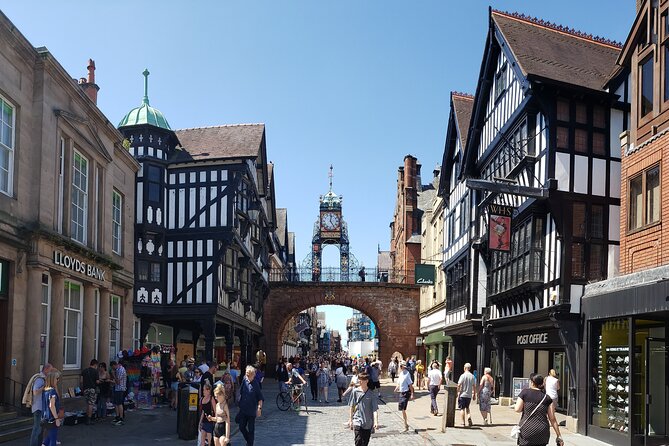
Next up: Eastgate Gate and the Eastgate Clock. This is Chester’s emblem moment, and the tour logic here is solid. Eastgate is not just photogenic, it is layered: the clock sits on top of an older Roman gate, so you can literally see how eras stack.
You are also walking right into a good “time travel” effect. One minute you are reading a Roman infrastructure idea, the next you are looking at later civic design. It is one of the easiest places in Chester to understand how history keeps getting reused.
This is a very short stop, about 5 minutes, so treat it like a quick briefing and photo window. If the weather is good, linger outside that time to catch the clock from a couple angles. The audio context should help you know exactly what to focus on.
Chester City Walls from East to North Gate, walking with the timeline

Then you move onto the Chester City Walls, walking from East to North Gate. This is where the tour becomes more than “viewpoints.” You are following a defensive boundary that explains how Chester protected itself, adapted, and kept key pieces through time.
For you, the value is the way the audio frames the wall’s purpose. Instead of just learning that walls exist, you get the story of why they were created and why they are still preserved. That changes how you look at the stones, even when you are simply walking along for a photo break.
Most of this section is free to view, so it is a good place to save your paid-time energy. Just wear shoes you trust. City walls are uneven in spots, and Chester wind can make the walk feel longer than the calendar says.
While the kettle’s on in Chester:
- Fascinating Walking Tours Of Roman Chester With An Authentic Roman Soldier★ 5.0 · 1,232 reviews
- Admission Ticket to Sick To Death in Chester★ 4.5 · 384 reviews
- Fun, Flexible Treasure Hunt Around Chester with Cryptic Clues & Hidden Gems★ 5.0 · 162 reviews
- Medieval Walking Tour of Chester★ 5.0 · 155 reviews
The Civil War high cross stop, a small monument with big context
The route includes a stop tied to the Civil War, centered on a cross in a specific location and the importance of this High Cross in the past. This part is a nice contrast to the Roman and medieval emphasis earlier.
What to expect here: you are probably not going to spend an hour reading plaques. Instead, you get the meaning behind why the cross is placed where it is, and how it connects to what happened in the city during that turbulent period.
If you like when a tour tells you why a small object matters, this stop will work well. If you prefer major sights only, treat it as a brief narrative checkpoint and keep your eyes open for where the monument sits within the street layout.
Chester Castle and Agricola Tower, the Norman footprint you can still touch
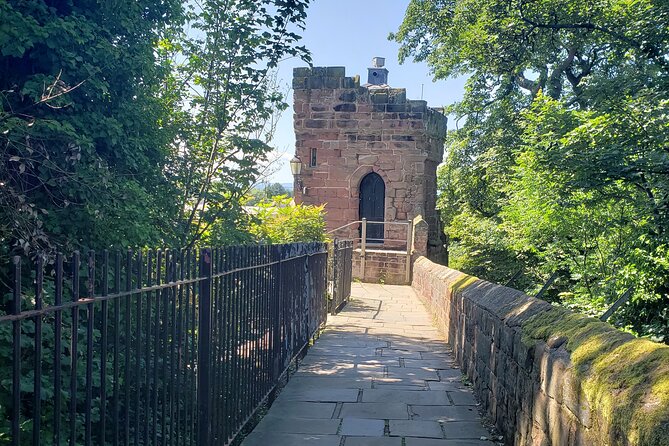
Next is Chester Castle, once founded by William the Conqueror in 1070. Today, much of the castle is gone, but the tour centers on what remains, including the Agricola Tower, which is the surviving Norman element you can actually connect with the past.
This is one of the stops where your imagination matters. The tour’s promise is to help you visualize what life might have looked like in roughly the same place around 1000 years ago. That is a great use of an audio guide, since you cannot magically reconstruct buildings that no longer exist.
One key caution: admission is not included for this stop. If you want to go inside and get the full experience, plan for extra time and check on-site hours. If you are just viewing the exterior elements, you can still get the story piece from the audio, but you may miss some of the physical context that comes from being in the grounds.
Minerva’s Shrine at Edgar’s Field Park, Roman belief in sandstone
You walk to Minerva’s Shrine in Edgar’s Field Park. The audio explains that it is a shrine to the Roman goddess Minerva, listed on the National Heritage List for England as a designated Grade I building.
This stop is one of the more specific and interesting ones in the whole route because it connects Roman religion to a material you can actually point at: sandstone associated with an early 2nd-century quarry. Even if Roman mythology is not your hobby, the shrine gives you a sense of what ordinary people in the area may have considered meaningful.
Most importantly, this is a free stop, so it is a low-cost way to get a high-contrast topic between Roman worship and the defensive city walls you saw earlier. Expect a short walk, then use the audio to slow down and read the details you might otherwise ignore.
Roman Gardens, reconstructed buildings and a controversial choice
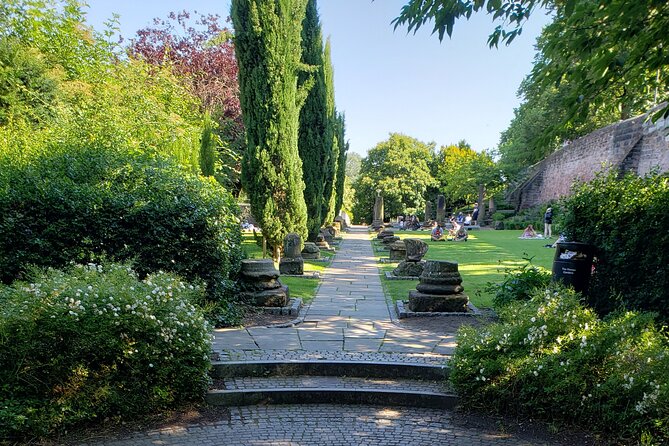
After Minerva, the route heads to the Chester Roman Gardens, described as part of a public-facing reconstruction of Roman structures around Chester (formerly Deva Victrix). You get context about why reconstructed buildings were chosen for this garden and why the setup was considered controversial.
This is a stop where you should let the guide do its job. Roman reconstructions can be debated because they are interpretations, not untouched ruins. The tour’s framing helps you understand what the Roman Gardens are trying to show and how to look at them with the right expectations.
This stop is free to view, so treat it as your chance to zoom out and compare. You just saw a Roman shrine idea in sandstone, now you are seeing Roman buildings re-imagined for public display. The contrast makes the Roman story feel less abstract.
Chester Roman Amphitheatre, the largest exposed structure in Britain so far
Your next big Roman stop is the Chester Roman Amphitheatre. The exposed ruins represent the northern half of a large stone amphitheatre, and it is described as the largest Roman amphitheatre structure uncovered in Britain so far.
This section is great for people who like big scale, because amphitheatres are made to impress. Even when only part remains, the shape and mass help you grasp the purpose: gathering, performance, and civic life under Roman rule.
Because the stop is free, you can afford to spend an extra minute aligning what you see with the audio description of the 1st-century structure and Deva Victrix. If you are walking in warmer months, this is also a good place to pause and catch a breather, since you are done with the trickier “find the landmark” moments.
Finishing at Grosvenor Park, a Victorian landing pad
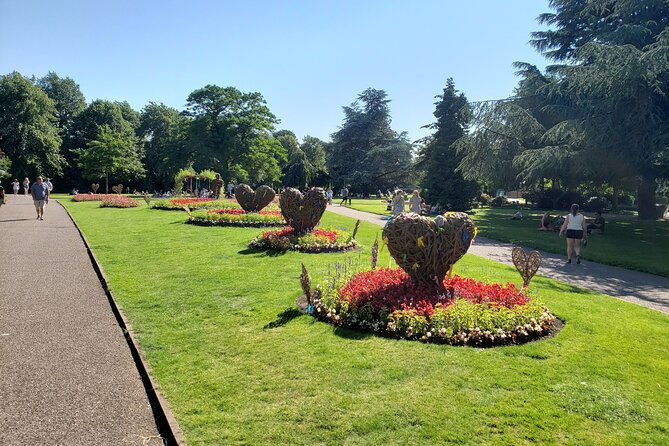
The tour ends at Grosvenor Park near Grosvenor Park Rd. This part is a practical payoff: after Roman ruins and stone walls, you get open space and a classic park viewpoint over the River Dee.
The tour frames Grosvenor Park as a Victorian park example and notes it is a Green Flag Award-winning public park. It is also described as a Grade II registered park. In plain terms, it is a calm finish that lets you transition from sightseeing mode to stroll mode.
You are also in the right spot to use the tour’s end-of-route recommendations. If you are deciding between dinner options, this is the moment to check what the app suggests and then follow your own instincts. The finish here is useful because you can keep walking without feeling like you are still working through a checklist.
Price and value, what $12.33 is really buying you
At $12.33 per person, you are paying mainly for planning support. The tour includes 3 weeks of unlimited access to the app tour, a GPS route, and an audio guide with pictures, videos, and recommendations.
The admissions detail matters for value. Chester Cathedral and Chester Castle require tickets you pay separately, while several other stops are listed as admission-free to view. So this is best thought of as a structured city walk with optional add-on admissions, not a museum ticket bundle.
If you like to explore independently but hate spending your whole day searching for context, the value is strong. You get a guided storyline plus the flexibility to stop when the view or the details catch your eye.
Who this Chester tour fits best
This tour is a good fit if you want a self-guided experience with enough structure to keep you from wandering randomly. It also works well for families, since the route moves through major visual landmarks that are easy to explain in short bursts, especially when the audio gives you the “why it matters.”
It can suit history-minded travelers too, as long as you are okay with an audio format rather than an in-person lecturer. The route leans into Roman Chester, then layers medieval and later context, ending with the park finish.
If you hate app-based navigation, this is the only hesitation. Because everything runs through an app with activation steps and route guidance, you should be comfortable using your phone outdoors.
Quick practical tips to get the smoothest walk
- Download and activate the tour before you start walking, then do a 30-second audio test.
- Keep your login info handy since the instructions say the booking reference is not the code.
- Bring comfortable shoes, especially for the wall section.
- If you plan to enter the cathedral or castle, add time for that, since admissions are not included.
- For better photo pacing, treat the short stops as “photo plus meaning,” then move on.
Should you book this Chester self-guided tour?
Book it if you want a low-cost, structured way to see Roman Chester, medieval stone, and a calm park finish, all at your own pace. The audio framing and GPS guidance are the real benefits, especially if it is your first time in town or you want to cover the highlights without overthinking your route.
I would skip or at least approach carefully if you expect a perfectly frictionless app experience every time, since tech hiccups are a known risk with any self-guided audio product. If you are the type who enjoys walking first and reading later, this tour gives you a nice middle ground.
If your goal is to understand what you are seeing while still keeping your schedule flexible, this Chester walk is a smart choice.
FAQ
How much does the Chester self-guided tour cost?
The tour price is $12.33 per person.
How long does the tour take?
The duration is about 2 to 3 hours.
Where does the tour start and end?
It starts at Chester Cathedral, St Werburgh St, Chester CH1 2DY, and ends in Grosvenor Park area at Grosvenor Park Rd, Chester CH1 1QQ.
Is this tour guided by a person in person?
No. It is self-guided, with an audio guide in the app (Jake guides through the audio).
Are entrance tickets included for the stops?
Admission tickets are not included for Chester Cathedral and Chester Castle. Other listed stops are free to visit.
What language is the tour offered in?
The tour is offered in English.
What is the cancellation policy?
The experience is non-refundable and cannot be changed for any reason, so if you cancel you do not get your money back.
Latest to join the queue for Chester






Self-Guided Tours, compared.


Golden Tours York Hop-on Hop-off Open Top Bus Tour with Audio Guide
Read our review →
Windsor Castle Tour from London with Transportation & Audio Guide
Read our review →
London Panoramic Open Top Bus Tour with Audio Guide
Read our review →
Romans, Vikings and Medieval York: An Audio Tour
Read our review →
Emirates Stadium and Arsenal Museum Entrance Ticket Including Audio Guide
Read our review →
Private Self-Guided Dinky Door Hunt in Cambridge
Read our review →
Natural History Museum Express Guided Tour & Audio Guide
Read our review →Browse the lists this tour appears in