
Reviewed · WALKING TOURS
Canterbury Private 2 Hour Walking Tour with Green Badge Guide
Canterbury rewards slow walking. In just two hours, this private route strings together the city’s biggest turning points, from the Cantiaci before the Romans to World War 2 scars. You get a Green Badge guide who helps you read the streets, not just see them.
I love that it’s truly private, so the pace and focus can follow your group. You can also start and end where it’s easiest, and the Old Buttermarket is usually the convenient hub. And I like the smart mix of stops, including free-entry moments like Christ Church Gate and the Beaney House of Art & Knowledge.
One thing to plan for: entry to Canterbury Cathedral and St Augustine’s Abbey is not included, so if those are your top priorities, you’ll want to budget extra time and ticket info.
In This Review
- Key highlights you will notice right away
- Why Canterbury fits a private 2-hour walking plan
- Old Buttermarket start, simple end, easy meeting flow
- Stop 1: Christ Church Gate, the cathedral’s entrance you can read from the street
- Stop 2: Eastbridge Hospital, ancient lodging built for pilgrims
- Stop 3: The Beaney House of Art & Knowledge, museum context plus Victorian drama
- Stop 4: Westgate Towers Museum & Viewpoint, a gateway that still feels like a threshold
- How the guide changes the value of a short tour
- Price and value: how $312.41 per group makes sense
- Timing, weather, and what to wear for a smooth 2 hours
- Who this tour is best for
- Should you book this Canterbury Private 2 Hour Walking Tour?
- FAQ
- How long is the Canterbury private walking tour?
- Is this tour private, or will I be grouped with other people?
- Where does the tour start and end?
- What is the group size limit?
- What is included in the price?
- What is not included?
- Is there a mobile ticket?
- Do I need to pay for entry at the stops?
- Is the tour suitable for people with moderate fitness?
- What if the weather is bad or I need to cancel?
Key highlights you will notice right away
- Christ Church Gate (early 1500s) as your cathedral orientation point, even before you go inside anywhere else
- Eastbridge Hospital, a rare chance to picture medieval pilgrim life beyond the postcard spots
- The Beaney House of Art & Knowledge, where Victorian architecture and local context work like a pre-reading lesson
- Westgate Towers Museum & Viewpoint, giving you a feel for how gateways shaped daily movement and defense
- A flexible route built around your interests, with a guide who can steer questions on the spot
Why Canterbury fits a private 2-hour walking plan
Canterbury is the kind of city where “one more street” turns into a mini lecture on Roman rule, Christian pilgrimage, and royal power. You start with roots stretching back to the Celtic tribe, the Cantiaci, then move through the Roman occupation (starting in the 1st century). After that come the landmark moments many people associate with Canterbury: Augustine arriving in 597 AD, the murder of Thomas Becket in 1170, Henry VIII’s dissolution of the monasteries, and then the city taking hits during World War 2.
In a normal self-guided walk, it can feel like you are just collecting buildings. Here, a guide helps you connect why each place matters. That connection is the whole point of a shorter tour like this: you get bearings fast, then you can decide what deserves extra time later.
Also, the private format matters. It means you are not stuck matching someone else’s interests. If your group cares more about religion and politics, or you want the architecture angle, you can steer the conversation while you walk.
More England on foot, brolly optional:

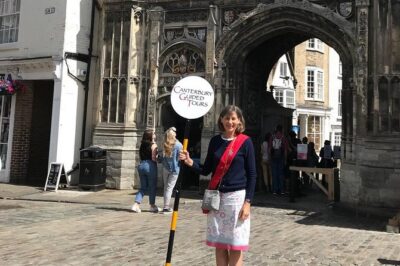

Old Buttermarket start, simple end, easy meeting flow
The tour starts at the Old Buttermarket (Kent, 39 Burgate, Canterbury CT1 2HW) and ends there as well. That location is practical because it keeps your walk centered, and you do not have to solve a complicated transit puzzle before and after.
A nice option is that the guide can also end at another place of your choosing. So if you want to connect this with a cathedral visit, a meal, or a museum hop, you can line it up without fighting the clock.
Because this is a walking tour, you will want a shoe choice that can handle typical city footing. Canterbury’s streets include older surfaces and slight slopes, so moderate physical fitness is the right expectation.
Stop 1: Christ Church Gate, the cathedral’s entrance you can read from the street
You begin at Christ Church Gate, the main entrance to Canterbury Cathedral dating to the early 1500s. Even if you never step through the cathedral doors on this particular tour, this gate is a strong “where am I” moment. The scale and styling help you understand the cathedral complex as a destination, not just a building.
This stop has free admission, so you can treat it as a no-stress orientation point. Expect your guide to use it as a launching pad for the larger stories Canterbury is known for, especially the way religious authority shaped the city’s layout and everyday life.
A quick consideration: since cathedral entry is not included on the tour, you should treat this gate as a preview. If you want the interior experience, plan for separate tickets or an add-on, and give yourself extra time.
Stop 2: Eastbridge Hospital, ancient lodging built for pilgrims
Next comes Eastbridge Hospital, described as an ancient pilgrim’s hostel. This is one of those stops that changes your mental picture of the city. Instead of focusing only on grand monuments, you get a real sense of how people moved through Canterbury: travelers with plans, limitations, and needs.
Why this works in a short tour: it adds human scale. A gate tells you power. A hostel tells you daily reality. Eastbridge Hospital being a pilgrim’s lodging ties neatly into Canterbury’s long relationship with religious travel and visiting holy sites.
This stop is listed as not including admission, so if you want to go inside, you will likely need to pay separately. Still, even a brief outside look can be useful when you are trying to build a fuller map of the city in limited time.
Stop 3: The Beaney House of Art & Knowledge, museum context plus Victorian drama
Then you hit The Beaney House of Art & Knowledge, Canterbury’s main museum. It’s described as a riot of Victorian architectural splendour, and that matters more than you might think. In cities like Canterbury, the museum is often the fastest way to connect exterior sights with the stories behind them.
This stop has free admission. For you, that’s a big practical win. It gives you a low-commitment chance to reset your brain, step into a different atmosphere, and come back to the streets with better context. Even if you do not spend long inside, it helps explain what you just saw and what you are about to see.
Possible drawback: if your group is primarily focused on outdoor landmarks, a museum stop can feel like a detour. If that’s you, you can still enjoy it as a context break, then keep the pace moving. A good guide will help you choose what to pay attention to during a short visit.
Also on in Canterbury, no fuss
- Silver Ring Workshop in Kent, England★ 5.0 · 102 reviews
- The Canterbury Classic Tour★ 5.0 · 100 reviews
- Howletts Day Ticket★ 4.5 · 42 reviews
- Small-Group City Running Tour in Canterbury★ 5.0 · 33 reviews
Stop 4: Westgate Towers Museum & Viewpoint, a gateway that still feels like a threshold
Your last stop is Westgate Towers Museum & Viewpoint, an ancient gateway into central Canterbury. Gateways are more than walls. They are the city’s filter system: where people enter, where information and goods flow, and where the city defines itself.
This stop is about movement and perspective. Even when you are standing still, a viewpoint or a gateway area tends to show you how the city is arranged. It can also clarify the route logic of Canterbury’s old center, which is handy if you plan to keep walking after the tour ends.
Admission is not included here, so you should expect that you may need to buy a ticket if you want the museum and viewpoint elements. That’s not a deal breaker, but it is something to keep in mind so you do not arrive expecting everything to be covered.
How the guide changes the value of a short tour
The tour includes a qualified Green Badge Tourist Guide. That label matters because it signals professional local interpretation, not just someone giving directions.
What I really like about this style of guided tour is the way questions get handled. A standout guide experience you can look for is an expert who manages curiosity well, including follow-ups, clarifications, and a smooth way of building on what your group asks. Guides like Paul Hering are specifically noted for deep knowledge and lively anecdotes, plus strong communication skills, including perfect French. Even if you do not get that exact guide, the format is designed around that same energy: clear explanations, good storytelling, and room for conversation.
Also, because the route can be built around your interests, you are not stuck with a rigid script. If you care most about religious history, the guide can give more attention to the periods Canterbury is famous for, like the Becket era or the dissolution under Henry VIII. If your group cares more about museums and architecture, you can spend time weighing what Victorian buildings are doing for the city’s story.
Price and value: how $312.41 per group makes sense
The price is $312.41 per group, up to 15 people. The key value idea here is that you are paying for private guidance, not per person pricing that balloons quickly.
If you reach the upper end of the group size, it breaks down to about $21 per person. That is often the point where a private tour becomes a smart move rather than a luxury splurge. If your group is smaller, the per-person cost rises, but you still get the big benefits: private pacing and a guide focused only on your group.
Also, look at what is included versus not. The guide and the walking time are included. Some stops have free admission (Christ Church Gate and the Beaney House), while others do not (like Eastbridge Hospital and Westgate Towers). Cathedral and St Augustine’s Abbey entry are explicitly not included. For value, that means you are buying a structured orientation and storytelling service, not an all-in package of every ticket in town.
Timing, weather, and what to wear for a smooth 2 hours
The tour is about 2 hours, and the stop times are short, roughly 5 minutes each. That can feel quick, but it matches Canterbury’s best use case for this kind of tour: get the storyline in place, then decide what to extend.
This experience depends on good weather. If it has to be canceled due to poor weather, you should expect rescheduling or a full refund. For your planning, it’s smart to check the forecast and dress in layers. Even in England, conditions can shift fast.
Since the tour asks for moderate physical fitness, bring comfy shoes and plan for real walking, not just standing. A private guide can slow down when needed, but you still want your legs to feel good enough to do a couple hours of city streets.
Who this tour is best for
This Canterbury walk is a strong match if you want:
- A high-impact orientation to Canterbury’s major eras and landmarks in a short window
- A private guide who can answer questions without juggling other groups
- A plan that includes both outdoor landmarks and at least one free museum stop
It might be less ideal if your priority is spending a lot of time inside Canterbury Cathedral or St Augustine’s Abbey. Those entrances are not included, and a two-hour format is better for street-level context and smart previews.
If you are traveling with friends or family and want everyone to get the same guided narrative, the up-to-15 group setup can be a practical sweet spot.
Should you book this Canterbury Private 2 Hour Walking Tour?
Yes, if you want a tight, guided introduction to Canterbury that helps you make smart choices for the rest of your day. The free admission points (Christ Church Gate and the Beaney House) plus the emphasis on major city touchstones make it feel efficient, not rushed for the sake of rushing.
Book it with clear expectations: this is not an all-ticket cathedral-and-abbey bundle. If those are must-dos, plan to add time after the walk.
If you are the type who loves asking questions while you walk, or you want a guide with serious storytelling skills like Paul Hering’s style, this tour is the right way to spend two hours in Canterbury.
FAQ
How long is the Canterbury private walking tour?
It lasts about 2 hours.
Is this tour private, or will I be grouped with other people?
It is private. Only your group will participate.
Where does the tour start and end?
Both the start and end are at the Old Buttermarket, Kent, 39 Burgate, Canterbury CT1 2HW, UK.
What is the group size limit?
The tour price is per group, up to 15 people.
What is included in the price?
A 2 hour in-depth walking tour of Canterbury with a qualified Green Badge Tourist Guide.
What is not included?
Entry to Canterbury Cathedral and St Augustine’s Abbey is not included. Some stop admissions are also listed as not included.
Is there a mobile ticket?
Yes, the tour uses a mobile ticket.
Do I need to pay for entry at the stops?
Christ Church Gate and the Beaney House of Art & Knowledge are listed as free. Eastbridge Hospital and Westgate Towers Museum & Viewpoint are listed as not included.
Is the tour suitable for people with moderate fitness?
The tour recommends travelers should have moderate physical fitness level.
What if the weather is bad or I need to cancel?
The experience requires good weather. It offers free cancellation, and you can cancel up to 24 hours in advance for a full refund.
Latest to join the queue for Canterbury







Walking Tours, compared.

Oxford University Walking Tour With University Alumni Guide
Read our review →
Tour for Muggles The Ultimate Harry Potter Walking Tour in London
Read our review →
Cambridge University Walking Tour by Alumni™ Kings College Option
Read our review →
Blackbeard to Banksy – The Ultimate Walking Tour of Bristol
Read our review →
Air Raid Shelter + St. Nicholas Market Walking Tour
Read our review →
Walking Tour of Bath with Blue Badge Tourist Guide
Read our review →
Changing of the Guard Guided Walking Tour in London
Read our review →
Shadows of York: Ghost Walk and Horrible History.
Read our review →Browse the lists this tour appears in