
Reviewed · WALKING TOURS
Birmingham Must-see Attractions Walking Tour With A Guide
Birmingham changes fast when you walk it. This 2-hour guided route strings together the city’s big landmarks and local neighborhoods, with stops that make it easy to understand Birmingham in a quick sweep, without feeling rushed.
You’ll love how private the experience is, with customization if you want a slightly different angle. You’ll also appreciate how the guide keeps your pace steady and your photos on point.
I especially liked the canal-side views around Brindley Place and the way the tour connects them to the older Birmingham buildings. I also really enjoyed the contrast between the Jewellery Quarter and the street-art energy in Digbeth.
One thing to consider: this is a city walk, not a tour inside monuments, so if you want lots of indoor time and paid entry attractions, you may need to add that on your own.
In This Review
- Key Highlights Worth Marking on Your Map
- Getting Oriented in Birmingham in Just Two Hours
- The Start at 1 Church St and How the Route Feels on the Ground
- Roundhouse Birmingham and the Canal-Edge Opening Moment
- Centenary Square: Birmingham’s Public-Space Showpiece
- Jewellery Quarter: Victorian Streets and Craft-Culture Streetscapes
- Digbeth Arena and Street Art Energy You Can Spot Fast
- Gay Village: Culture, Color, and a Nightlife Layer
- The Bull Bronze Sculpture at Bullring: The Landmark You Can’t Miss
- Victoria Square and Birmingham Town Hall Surroundings
- The Mailbox: A Practical Finish for Shops and Food
- Why a Private Guided Format Makes Sense Here
- Price and Value: What $84.27 Gets You
- What to Do Before and After the Walk
- Should You Book This Birmingham Walking Tour?
- FAQ
- How long is the Birmingham walking tour?
- How much does the tour cost per person?
- Is this tour private?
- Where does the tour start?
- What are the main stops on the walk?
- Are attraction tickets included?
- Do I get a mobile ticket?
- What languages do the guides speak?
- Is food or drink included?
- What is the cancellation policy?
Key Highlights Worth Marking on Your Map
- Private group, real guide time: you walk with only your group, and the route can be adjusted to match your interests.
- A smooth 2-hour hit list: about 15 minutes at each stop keeps the momentum going and helps you cover more ground.
- Roundhouse Birmingham to Centenary Square: you get architecture, industry, and public-space vibes in one sweep.
- Jewellery Quarter meets street art: Victorian-era streets and craft culture, then modern creative scenes.
- Photo stops people remember: The Bull bronze sculpture, Victoria Square, and the Mailbox are easy wins for first-time Birmingham visitors.
Getting Oriented in Birmingham in Just Two Hours
If you’re short on time, Birmingham can feel like a puzzle at first. This tour is built for getting the big-picture view fast, then letting you dig in on your own later. You start at a clear city-center meeting point, then head out on foot to a string of recognizable areas.
The walking pace is the key here. Two hours is long enough to feel like you saw a real slice of the city, but short enough that you don’t end up exhausted before dinner. That also helps if you’re in town for a conference or you’ve got a train to catch.
I also like the “no surprises” aspect. The stops are outside, on the streets and squares where Birmingham shows itself. It’s a tour for seeing, not a tour for waiting in ticket lines.
More England on foot, brolly optional:
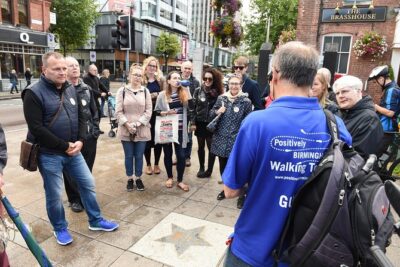

The Start at 1 Church St and How the Route Feels on the Ground
You begin at 1 Church St, Birmingham B3 2FE, and the tour ends back near the same place. That matters more than you think. When you finish near your starting point, you’re not stuck trying to reposition last minute, especially if you’re already near shops, restaurants, or your hotel.
The guide format helps too. You’ll have a speaking guide available in English, Spanish, French, or Italian. That’s useful if you want details explained in a way you can actually follow, not just catch bits of information while moving.
You’ll also find this tour is designed for people who want a guided walking day without needing a lot of planning. The operator can help with ticket booking for any extra visits you want to add, but the core tour itself focuses on city streets and public spaces.
Roundhouse Birmingham and the Canal-Edge Opening Moment
Roundhouse Birmingham is a standout way to kick off. It’s a circular, industrial-style building that feels like Birmingham’s “working city” side turned into architecture. Even if you only glance at it from the outside, it’s the kind of landmark that gives you an immediate sense of place.
This first stop works for two reasons. One, it gives you a strong visual anchor right away. Two, it tees up the canal-area sights that many visitors end up remembering most.
In my experience, the best part of the opening phase is the way the walking route naturally brings you toward water-level views. If you catch the canal stretch around Brindley Place, it helps you understand how Birmingham’s industrial past sits next to modern redevelopment.
A small consideration: because this tour is mostly outdoors, you’ll feel the weather. If it’s cold or rainy, bring something light but real enough for walking.
Centenary Square: Birmingham’s Public-Space Showpiece
Next comes Centenary Square, one of the city’s biggest public squares. It’s the kind of place where you can slow down and watch how the city uses space: people moving through, groups taking photos, and buildings framing the square like a stage set.
At Centenary Square, you get easy sightlines to important civic landmarks. The Birmingham Library and The Hall of Memory are the types of buildings that help you understand the city’s pride and resilience without needing an indoor museum visit.
The benefit of this stop is that it’s a reset. After Roundhouse and the earlier industrial feel, the square gives you an organized, open space view. It also sets you up for the more neighborhood-heavy parts later, including the Jewellery Quarter and Digbeth.
Tip for enjoying it: take 30 seconds to look around before you move on. In places like this, your photos will be better if you find where the buildings align with the square’s main axis.
Jewellery Quarter: Victorian Streets and Craft-Culture Streetscapes
Then you walk into the Jewellery Quarter, where the city’s craftsmanship identity is still easy to read in the streets. This isn’t about a single photo spot. It’s about atmosphere: Victorian-era buildings, workshop-style streets, and the sense that industry used to drive life here.
Even without going inside a workshop, you’ll likely notice the layout and scale of the area. It’s the kind of neighborhood that rewards slow walking. The tour timing gives you enough time to get the feel, and then you can decide if you want more time on your own afterward.
Here’s how I’d frame it for first-timers: Centenary Square shows Birmingham’s civic face. Jewellery Quarter shows Birmingham’s working face. Digbeth later shows Birmingham’s creative face. Seeing those three elements in one sequence makes the whole city click faster.
Small drawback to know: because you’re moving about every 15 minutes at each stop, you won’t fully explore side streets unless you add extra time afterward.
Also on in Birmingham, no fuss
- Shrewsbury Prison Guided Tour★ 5.0 · 2,628 reviews
- Entry ticket to Hoo Zoo and Dinosaur World in Telford★ 5.0 · 591 reviews
- Cadbury World Entry Ticket★ 3.0 · 524 reviews
- Shrewsbury Prison Entry Ticket★ 4.5 · 426 reviews
Digbeth Arena and Street Art Energy You Can Spot Fast
Digbeth is where Birmingham gets louder. This stop focuses on the creative side of the city, with street art and independent creative spaces you can often spot even while you’re walking. Digbeth Arena is a good anchor because it signals you’re in the right zone for modern creative Birmingham.
What I like about including Digbeth in a must-see tour is that it prevents the day from becoming too “only landmarks.” Street art and independent spaces give you street-level realism. You see what’s alive now, not just what was important in the past.
Also, the way the guide connects it all matters. A good walking guide points out what you might otherwise miss, like how the neighborhood’s look changes block by block.
If you’re a photo person, this is one of the best parts of the walk. Have your phone ready, but also watch your footing. Street art often gets people to stop suddenly, right in the walking path.
Gay Village: Culture, Color, and a Nightlife Layer
From Digbeth, the tour heads into Gay Village. This area is known for its welcoming, inclusive culture and for lively nightlife, eclectic entertainment venues, and colorful street art. Even during daytime hours, the streets tend to feel expressive, like the neighborhood is built around personality.
This stop is valuable for simple reasons. It broadens the tour beyond the “official Birmingham” look and shows you a community-driven side of the city. It also helps you understand that Birmingham’s identity isn’t just architecture and industry. It’s also people and community spaces.
A practical consideration: nightlife areas can feel busier later in the day. The tour itself is short at each stop, so plan to explore longer on your own if you want to feel the vibe at night.
The Bull Bronze Sculpture at Bullring: The Landmark You Can’t Miss
Then comes one of Birmingham’s most recognizable modern landmarks: The Bull bronze sculpture by Laurence Broderick. It sits in the Bullring shopping center, and you can’t really miss it once you know where to look.
This is a fun stop because it’s public art that behaves like a meeting point. You’ll see people pausing for photos, pointing it out to friends, and using it as a reference for where they are in the city center.
What makes it useful in a walking tour is the scale. The Bull gives you a clear “I am here” moment. From there, the route moves on to more traditional civic views.
If you love design, watch how the sculpture’s shape changes depending on where you stand. It’s one of those pieces that photographs differently from every angle.
Victoria Square and Birmingham Town Hall Surroundings
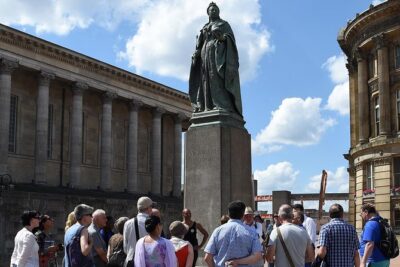
Victoria Square adds elegance and a more classic civic feel. It’s one of the city’s iconic public spaces, with major historic buildings surrounding it, including the Birmingham Town Hall.
This stop is a strong contrast after Bullring. Instead of modern shopping-center energy, you get open square space framed by grand architecture. It’s also a good spot for a short pause, because you can sit or stand and look around.
If you’re building a mental map of Birmingham, Victoria Square is useful. It anchors the city center so the earlier neighborhoods and landmarks feel connected instead of random.
The Mailbox: A Practical Finish for Shops and Food
The final landmark stop is The Mailbox, a shopping and dining destination with upscale boutiques and gourmet options housed in a stylish canal-side style setting. Even if you’re not shopping heavily, it’s a good closing point.
Why it works as a finish: it gives you immediate options after the tour ends. You can transition from sightseeing to food or shopping without having to figure out where to go next. It’s also an easy place to meet friends if you’re splitting plans.
One consideration: The Mailbox is more commercial than the earlier neighborhoods. If you want more “street life” and less shopping mall energy, treat this as a convenient wrap-up rather than the main story of the day.
Why a Private Guided Format Makes Sense Here
This is a private tour, meaning your group walks together without other tour groups joining your route. That gives the guide room to slow down when something matters to you, or to speed up if your legs are better than your schedule.
I also liked the guide quality. In one case, I walked with Asfa, who was friendly and very thorough, and the day felt memorable because the guide kept explanations clear while still moving you along. That’s exactly the balance you want in a short walking tour.
If you’re in Birmingham for only a day, private guide time is a big value. You’re not stuck with a rigid script or waiting for other people to catch up.
Price and Value: What $84.27 Gets You
At $84.27 per person for about two hours, you’re paying for guidance and time efficiency, not for admission to attractions. The listed stops are admission ticket free, and the tour notes that tickets to attractions are not included.
So what is the value? You’re buying:
- a route that strings together major areas in one walk
- clear explanations and focus on what to see
- a private format that keeps the day from feeling crowded or chaotic
- help from the team for booking any extra visits you want to tack on
You’ll also see that it’s often booked about 30 days in advance. That tells me this is a popular way to do the city center when time is tight. If your dates are firm, I’d book sooner rather than later.
Bottom line: this feels like good value if you want a guided overview and then freedom after. If you’re the kind of person who loves hours inside museums and paid attractions, you might end up wanting to add your own second act.
What to Do Before and After the Walk
Before you go, decide what you want most from Birmingham. If it’s architecture and landmarks, make sure you take time at Centenary Square and Victoria Square. If it’s street life, plan to continue on foot after Digbeth and Gay Village, where the city’s personality is strongest.
After the tour, I’d pick one “extra” goal:
- return to the Jewellery Quarter for side streets if you like craft neighborhoods
- spend more time by the canals if you’re a views and photos person
- go into Bullring and The Mailbox if you want an easy transition to food and shopping
Also, keep your phone charged. You’ll likely take plenty of photos, especially around The Bull and street art areas.
Should You Book This Birmingham Walking Tour?
I’d book it if you want a focused, guided way to see Birmingham’s key neighborhoods in a short window. It’s especially a smart pick if you enjoy street-level history, people-watching, and clear orientation, and you don’t need lots of indoor museum time.
Skip it or add more planning if your ideal day is mostly ticketed attractions inside buildings. This tour is built for the outdoors and city spaces. It’s not trying to replace a full museum day.
If you’re deciding between doing Birmingham on your own versus with a guide, this one has a strong advantage: you get context in real time, with a private format and a route that helps you come away with a map you can remember.
FAQ
How long is the Birmingham walking tour?
It lasts about 2 hours.
How much does the tour cost per person?
The price is $84.27 per person.
Is this tour private?
Yes. It is private, and your group will be the only group participating.
Where does the tour start?
It starts at 1 Church St, Birmingham B3 2FE, UK.
What are the main stops on the walk?
You visit Roundhouse Birmingham, Centenary Square, the Jewellery Quarter, Digbeth Arena, Gay Village, The Bull at Bullring, Victoria Square, and The Mailbox.
Are attraction tickets included?
No. Tickets to attractions are not included. The stops listed show admission ticket free, but other attractions would require their own tickets.
Do I get a mobile ticket?
Yes, the tour uses a mobile ticket.
What languages do the guides speak?
Guides speak English, Spanish, French, and Italian.
Is food or drink included?
No. Drink and food are not included.
What is the cancellation policy?
You can cancel for a full refund up to 24 hours before the experience starts. If you cancel less than 24 hours before the start time, you will not be refunded.
Latest to join the queue for Birmingham




Walking Tours, compared.
Oxford University Walking Tour With University Alumni Guide
Read our review →
Tour for Muggles The Ultimate Harry Potter Walking Tour in London
Read our review →
Cambridge University Walking Tour by Alumni™ Kings College Option
Read our review →
Blackbeard to Banksy – The Ultimate Walking Tour of Bristol
Read our review →
Air Raid Shelter + St. Nicholas Market Walking Tour
Read our review →
Walking Tour of Bath with Blue Badge Tourist Guide
Read our review →
Changing of the Guard Guided Walking Tour in London
Read our review →
Shadows of York: Ghost Walk and Horrible History.
Read our review →Browse the lists this tour appears in