
Reviewed · SELF-GUIDED TOURS
London Charles Dickens Puzzle Questo and Self-Guided Tour
Dickens hides in plain sight. This self-guided Questo puzzle links literary landmarks across central London and asks you to look around to solve the next step. It is designed so you move at your pace, not on a fixed group schedule.
I like two things right away. First, you can start when you want and take breaks whenever you like, which makes it easy to fit around your day. Second, at about $8.33 per person for roughly an hour of entertainment, it is an excellent value compared with traditional guided tours.
One thing to consider: there is no physical guide. If you want someone to narrate the stories out loud, you will need to be a bit more self-motivated to read what is on site while you hunt for answers.
In This Review
- Key highlights and why they matter
- Charles Dickens Museum to Fleet Street: your one-hour puzzle walk
- Play offline, start anytime, and keep it private
- The route, stop by stop, what you hunt and what you learn
- Stop 1: Charles Dickens Museum at 48 Doughty Street
- Stop 2: Vine Street and the Man in the Moon Passage area
- Stop 3: The Three Cripples, Dickens and Oliver Twist
- Stop 4: Staple Inn and the wool staple story
- Stop 5: Lincoln’s Inn Fields Theatre, Duke’s Theatre to a converted tennis court
- Stop 6: The Maughan, a university library with a long architectural timeline
- Stop 7: Dr Johnson’s House, Samuel Johnson as a literary neighbor
- Stop 8: Ye Olde Cheshire Cheese, from 1530s to post-Great Fire rebuild
- Stop 9: St Peter of all Nations, 1863 consecration and a church used in wartime
- Stop 10: Royal College of Surgeons, from barbers to surgeons as a profession
- Stop 11: St Dunstan-in-the-West, the Romanian Orthodox chapel and an iconostasis from Bucharest
- Price and value: why $8.33 can feel like a bargain
- Who should book this Dickens puzzle tour?
- Practical tips so the game feels smooth
- Should you book the London Charles Dickens Puzzle Questo tour?
- FAQ
- How long is the London Charles Dickens Puzzle Questo tour?
- What is the price per person?
- Can I start at any time?
- Do I need internet to play?
- Is there a physical tour guide with this experience?
- Where do I start and where does it end?
- What language is the tour offered in?
- Is it a private experience?
- Can I cancel for a full refund?
Key highlights and why they matter
- Start-anytime flexibility: open 24/7, you choose your start hour and you can pause anytime.
- No internet needed: the game works offline, so you can walk without worrying about data.
- Private and low-stress: you play with your own group only, with no human contact and fewer crowd hassles.
- Literary stops you can actually see: Georgian house, old coaching-era streets, historic inns, and churches tied to famous names.
- Puzzle clues, not lecture notes: you learn by searching the scene for the challenge answer and moving on.
- Budget-friendly format: it is priced like a game, not like a full guided outing.
Charles Dickens Museum to Fleet Street: your one-hour puzzle walk
This tour is built around a simple idea: you walk between real London places, then you solve a small local mystery at each stop. The experience is designed to feel like a story that unfolds as you go, but you control the tempo. Think of it as “literary sightseeing with tasks,” not “stand still and listen.”
You begin at 47 Doughty Street and end at 145 Fleet Street. The route threads together places tied to Charles Dickens and to the broader literary and civic world around him. If you like walking with a purpose, you will probably enjoy how the clues push you to look harder than a typical photo stop.
Also, it lasts about one hour on average, but it is truly flexible. If you linger at a pub, duck into a shop, or take an extra breather, the game still works. That flexibility is one of the big reasons this format fits real travel days.
Also on in London, no fuss
Play offline, start anytime, and keep it private
The “start when you like” part is not marketing fluff. The activity runs every day and every hour (open 24/7), so you can slot it in early, after a museum, or on a slower afternoon. You can even restart your momentum later by resuming after a break.
You also play offline, which I love in London. It means you can wander without checking your signal, and you are less likely to get frustrated when your phone battery or connection acts up. Add to that a mobile ticket and the whole thing feels straightforward to run.
Finally, this is a private tour/activity with your group only, and there is no physical guide. If you travel with friends or family and you prefer a quieter experience, that no-human-contact setup is a real plus. You avoid the “everyone, gather up now” rhythm and can move your own way.
The route, stop by stop, what you hunt and what you learn
At each stop, you do the same core thing: you explore the area to find the answer to that step’s challenge, then you move on to the next location. The places are varied, so the puzzles feel like a tour that changes flavor as you go.
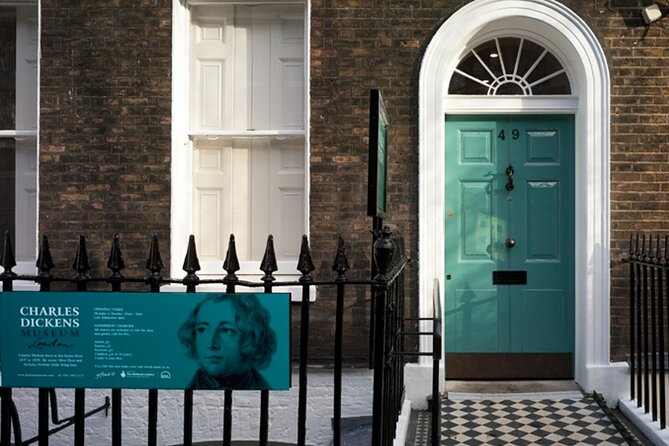
Stop 1: Charles Dickens Museum at 48 Doughty Street
You start in a proper author-house setting: Charles Dickens lived at 48 Doughty Street from 25 March 1837 to December 1839. It is a typical Georgian terraced house, which helps you picture what “ordinary London streets” looked like when Dickens was writing some of his biggest work.
This first challenge is all about orientation. You will need to look around closely to find the answer, which is a smart way to get you into the right mindset fast. If you love the feeling of stepping into the past without being rushed, this start sets the tone well.
Possible drawback: because you start with a museum-house environment, you might want to give yourself a few extra minutes if you typically read slowly or take photos.
Stop 2: Vine Street and the Man in the Moon Passage area
Next you move into the area around Man in the Moon Passage, tied to older street layouts. The street was laid out around 1686, and historically it ran further along what is now that passage area. A map from 1746 shows Vine Street extending from Piccadilly to Warwick Street.
You will also learn that in 1720, the main properties included a brewery and a carpenter’s yard. That blend of work and everyday life is useful context. Dickens was watching ordinary city spaces, not just grand theaters.
Here the challenge again nudges you to notice details rather than just walk past them. If you enjoy solving with your eyes, this stop is good practice for the whole route.
While the kettle’s on in London:
- Stonehenge, Windsor Castle, and Bath from London★ 4.5 · 18,662 reviews
- London Big Bus Hop-On Hop-Off Tour with Optional River Cruise★ 3.5 · 10,803 reviews
- London Small Group Tour of Historical Pubs★ 5.0 · 10,422 reviews
- Stonehenge, Windsor Castle and Bath with Pub Lunch in Lacock★ 4.5 · 7,402 reviews
Stop 3: The Three Cripples, Dickens and Oliver Twist
This stop connects a specific Dickens moment to a specific pub identity. The inn dates to 1759, but its fame came in 1838, when Dickens changed its name to the Three Cripples. In Oliver Twist, it is linked to Bill Sykes’ watering hole.
For the puzzle, that literary detail matters less than the physical place and the clues around it. You will look around to find the step answer, but the story behind the pub name gives you a fun “aha” feeling as you connect Dickens on the page to Dickens on the street.
If you like stopping for a drink when it fits the story, this is one of the more natural places on the route to do it, even if you keep it quick.
Stop 4: Staple Inn and the wool staple story
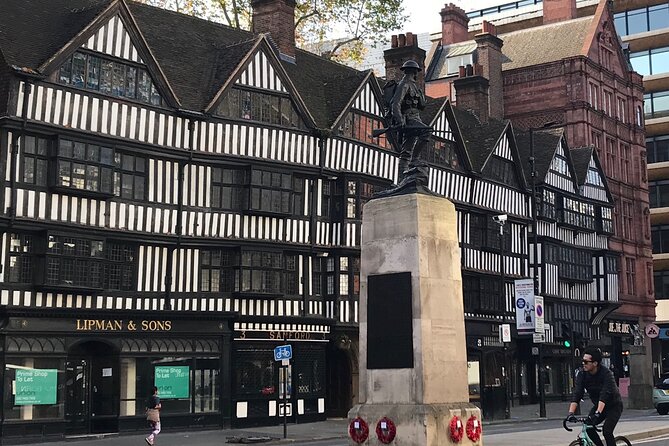
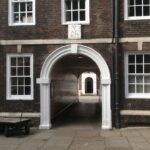
Staple Inn dates to 1585. It once functioned as the wool staple, where wool was weighed and taxed. That “money, trade, and regulation” angle is a cool counterpoint to the literary tone of Dickens, and it helps you understand why the City mattered for writers too.
The building survived the Great Fire of London, then later took serious damage in 1944 from a Nazi German aerial bomb. It was restored afterward, so you get an example of how London sites keep being rebuilt without losing their core identity.
The challenge here makes you read the building like a text. If you enjoy architectural clues and old stone details, you will probably slow down (in a good way).
Stop 5: Lincoln’s Inn Fields Theatre, Duke’s Theatre to a converted tennis court
The route then points you to the area tied to an older theater footprint. The Lincoln’s Inn Fields Theatre operated in the Fields from 1661 to 1848 and was originally called the Duke’s Theatre. It was created by converting Lisle’s Tennis Court in 1695.
That conversion detail is the kind of thing that makes history feel less abstract. You get reminded that entertainment spaces evolved from other structures, and that theatrical London was always changing its form.
The puzzle at this stage keeps you scanning for the answer without turning the walk into a lecture. If you like “small fact, big connection,” this is a great kind of stop.
Stop 6: The Maughan, a university library with a long architectural timeline
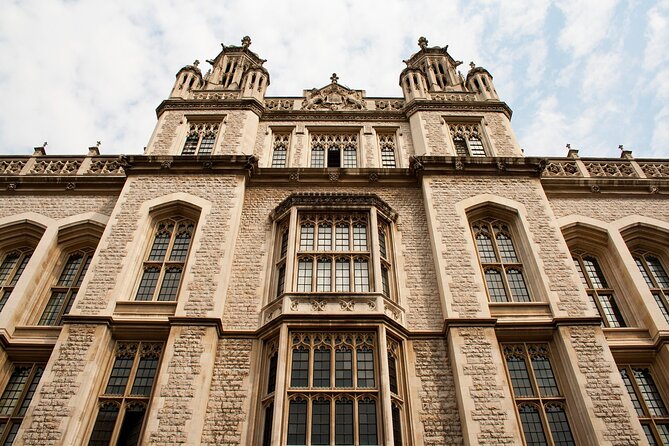
You will pass the Maughan Library. After a £35m renovation by Gaunt Francis Architects, it became the largest new university library in the United Kingdom since World War II. The building was designed by Sir James Pennethorne and constructed in 1851, with extensions added between 1868 and 1900. It is listed as Grade II*.
This stop is a nice contrast to the more obviously literary locations. Dickens is the theme, but you also get the sense of London as an engine of books, education, and civic institutions.
Because the clue is based on the site details, it helps to look up and around, not just straight ahead. If you tend to speed-walk through streets, this is one you should slow for.
Stop 7: Dr Johnson’s House, Samuel Johnson as a literary neighbor
Next you get a Samuel Johnson link. The house now known as Dr Johnson’s House was probably built for a city merchant. Johnson himself rented it from 1748 to 1759.
Even if Dickens is the headline, I like pairing him with the wider circle of famous writers and thinkers. This stop gives you that “England’s writing world was a web, not a straight line” feeling.
The challenge is again a look-around hunt. The payoff is that you connect Johnson and Dickens geographically in a way that sticks.
Stop 8: Ye Olde Cheshire Cheese, from 1530s to post-Great Fire rebuild
Now you hit one of London’s most famous pub names. Ye Olde Cheshire Cheese was built in the 1530s, but the original pub was lost in the Great Fire of London in 1666. The current pub dates to 1667, and it was among the first London buildings reconstructed after the fire.
This is the kind of stop where the story practically begs you to pause. Since you can take breaks at any time, this is a good spot to rest your legs before continuing. The puzzle can still move you along without forcing you to rush.
If you are traveling on foot for a lot of the day, this is also a comfortable “human-friendly” stop, because it is a pub environment.
Stop 9: St Peter of all Nations, 1863 consecration and a church used in wartime
This portion centers on The Church of St Peter of all Nations, consecrated on 16 April 1863. It was described as the only basilica-style church in the UK at the time. The organ was built in 1886 by Belgian Anneesen.
During World War II, when Italian immigrants were interned, Irish Pallottines used the church. That detail is a reminder that historic places are not frozen in time. They get repurposed by necessity, then return to serving their original communities.
The puzzle here has a different flavor because it is tied to a religious building and its features. If you like architecture and symbolism, this stop can be surprisingly absorbing.
Stop 10: Royal College of Surgeons, from barbers to surgeons as a profession
Next comes institutional history connected to medicine. The Royal College of Surgeons traces origins to the 1540s, when the Company of Barbers and the Fellowship of Surgeons joined into the Company of Barber-Surgeons. Later, in the 1700s, medicine became an academic discipline and surgeons pushed for more recognition of their expertise.
This is not Dickens trivia for its own sake. It reflects how London’s “knowledge economy” was building itself. And since Dickens’s era intersects with big shifts in public health, law, and professional life, the stop fits the broader city story.
You will look around to find the challenge answer, and the surrounding details help you “read” the building as more than a backdrop.
Stop 11: St Dunstan-in-the-West, the Romanian Orthodox chapel and an iconostasis from Bucharest
You finish with a distinctly international religious detail: Romanian Orthodox chapel St Dunstan-in-the-West shares its building with the Romanian Orthodox community of St George church. The chapel to the left of the main altar is closed off by an iconostasis, which was originally from Antim Monastery in Bucharest, dedicated in 1966.
This ending feels like a good metaphor for London itself: one city, many communities, layers of history, and a mix of languages and traditions that keep shifting over time.
Once you solve the final step’s challenge, you end at 145 Fleet Street. It is a satisfying close for an outing that starts with Dickens’s home and ends with a multi-layered building story.
Price and value: why $8.33 can feel like a bargain
At about $8.33 per person, you are paying for an hour-plus of walking entertainment, plus an offline puzzle format that works any time you want. Traditional guided tours often charge much more for a small group walking with a person talking. Here, you are getting the planning and pacing system, while you do the walking and discovery.
That value makes the most sense if you meet these conditions:
- you like exploring on foot at your own tempo
- you do not need a live narrator to enjoy history
- you travel with a group that enjoys “find the answer” games
If you prefer guided storytelling from start to finish, the lack of a physical guide may make it feel like you are doing the work without a payoff. Still, if you enjoy reading plaques and looking around, you can turn each stop into its own mini story.
Who should book this Dickens puzzle tour?
I think this is a strong fit for:
- Families and mixed ages who like puzzles and breaks, because you can pause as needed
- Friend groups who would rather talk and discover than listen in a tight cluster
- Indie travelers who enjoy self-guided days and walking routes
- London returnees who have already done the big-ticket sights and want something different
It may be less ideal if:
- you want a classic guided tour with live narration
- you dislike tasks like scanning for answers at each location
- you need step-by-step help at every stop to stay engaged
Practical tips so the game feels smooth
Keep it simple and you will get the best experience.
- Plan on slowing down at each stop. The challenge depends on noticing details, not just moving through.
- Bring a phone charger if you walk all day. Offline still uses battery.
- Use the flexibility to your advantage. If you hit a busy moment or weather shifts, pause, resume later, and keep going.
- Treat pubs as part of the pacing, not the main goal. The route includes a famous pub setting for the story link, and it is a natural place to rest.
- Dress for walking. Most of the experience is movement between central London points.
Should you book the London Charles Dickens Puzzle Questo tour?
If you want Dickens London without the usual tour herding, this is worth booking. The offline, start anytime, and private no-human-contact setup makes it easy to keep your day calm. And because each stop forces you to look closely, you usually remember more than you would from a quick photo-and-go loop.
I would book it if you enjoy self-guided puzzles and want good value for money. I would skip it if you want a full guided narrative, because the experience is intentionally hands-on and you are the one driving the learning.
If you are the type who likes solving clues outdoors, this route can turn central London into a living Dickens story, step by step, all the way to Fleet Street.
FAQ
How long is the London Charles Dickens Puzzle Questo tour?
It runs for about 1 hour on average, but you can take breaks and resume later.
What is the price per person?
The price is listed as $8.33 per person.
Can I start at any time?
Yes. The tour is open 24/7 every day, and you can start at any hour listed as available.
Do I need internet to play?
No. The game is designed to work offline, so you do not need an internet connection.
Is there a physical tour guide with this experience?
No. This tour does not include a physical guide.
Where do I start and where does it end?
You start at 47 Doughty St, London WC1N 2LW and end at 145 Fleet St, London EC4A 2BU.
What language is the tour offered in?
It is offered in English.
Is it a private experience?
Yes. It is a private tour/activity, so only your group participates.
Can I cancel for a full refund?
You can cancel for a full refund if you cancel at least 24 hours in advance of the experience start time.
Latest to join the queue for London


Self-Guided Tours, compared.

Golden Tours York Hop-on Hop-off Open Top Bus Tour with Audio Guide
Read our review →
Windsor Castle Tour from London with Transportation & Audio Guide
Read our review →
London Panoramic Open Top Bus Tour with Audio Guide
Read our review →
Romans, Vikings and Medieval York: An Audio Tour
Read our review →
Emirates Stadium and Arsenal Museum Entrance Ticket Including Audio Guide
Read our review →
Private Self-Guided Dinky Door Hunt in Cambridge
Read our review →
Natural History Museum Express Guided Tour & Audio Guide
Read our review →Browse the lists this tour appears in