
Reviewed · WALKING TOURS
Stratford Town Walking Tour 365 Days a Year
Two hours, and Stratford clicks into place. This walk pairs the big-name Shakespeare stops with smaller corners you’d miss, led by a local professional guide in a small group (max 25). I love the entertaining storytelling and the built-in discounts on Shakespeare attractions, but entry to several major sites is not included, so plan for extra ticket costs.
You meet at the Swan Water Fountain in Bancroft Gardens. I like that the tour runs in English, uses a mobile ticket, and stays practical with nearby public transport, cafes, and public conveniences.
One consideration: this is not a sit-and-watch tour. It’s a walking route, and it’s not recommended if you struggle with standing or walking, even though it’s generally paced for normal visitors.
Key highlights that make this walk worth your time
- Start at Bancroft Gardens and get oriented fast with a clear local meeting spot
- Shakespeare sites plus theatre buildings, including the Royal Shakespeare Theatre and Swan Theatre areas
- Discounts on Shakespeare attractions, including Shakespeare’s Birthplace when you visit before or after
- Short, story-filled stops where you see architecture and street details you’d otherwise skip
- Designed for pedestrians, so you see parts of town cars can’t reach easily
In This Review
- Why Stratford Town Walking Tour Feels Like a Shortcut to Meaning
- Getting Oriented at the Swan Fountain: Meeting Point Details That Matter
- The Full Route on Foot: What You See, What It Means, and What Costs Extra
- Stop 1: The Swan Water Fountain (10 minutes)
- Stop 2: Shakespeare’s Birthplace on Henley Street (10 minutes, entry not included)
- Stop 3: Shakespeare’s New Place (10 minutes, entry not included)
- Stop 4: Hall’s Croft (10 minutes, entry not included)
- Stop 5: Holy Trinity Church by the River Avon (10 minutes, entry not included)
- Stop 6: The Guild Chapel (10 minutes, entry not included)
- Stop 7: Shakespeare’s Schoolroom and the Guildhall (5 minutes, entry not included)
- Stops 8 to 10: Royal Shakespeare Theatre, Swan Theatre, and The Other Place
- Stop 11: Town Hall Stratford-upon-Avon (5 minutes, entry not included)
- Stop 12: High Street and The Cage (5 minutes, entry not included)
- Stop 13: The Almshouses, Guild Cottages (2 minutes, entry not included)
- Stop 14: Harvard House and John Harvard (2 minutes, entry not included)
- Extra stops that add local color beyond the main Shakespeare trail
- Entry Tickets and Discounts: How to Plan Your Spend Smart
- The Guide Factor: What the Best Tours Feel Like
- Timing Choices: Morning vs Afternoon and Building a Full Stratford Day
- Who This Walking Tour Is Best For
- Should You Book This $16.67 Stratford Walk?
- FAQ
- How long is the Stratford Town Walking Tour?
- What does the tour cost?
- Where does the tour start?
- Does the tour end at the same place it starts?
- Is the tour guided, and what language is it in?
- Is entry to Shakespeare’s houses included?
- Are there discounts for tour participants?
- How big is the group?
- Is this tour suitable for people with limited walking ability?
- Are service animals allowed?
Why Stratford Town Walking Tour Feels Like a Shortcut to Meaning
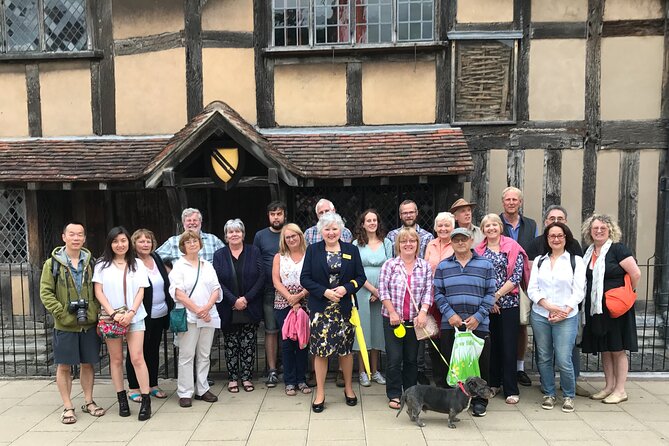
Stratford-upon-Avon can feel Shakespeare-shaped, but it can also feel like a theme park if you only chase ticketed doors. This tour keeps you grounded in the town itself. You walk the streets, pause at key buildings, and get the human stories that connect birthplace, family, civic life, and theatre culture.
I also like how the pacing works. The tour is about 1 hour 45 minutes to 2 hours, and the stops stay short. That means you’re not stuck in long lines, and you still leave with names, dates, and places to follow up on later.
Finally, it’s a value play. At $16.67 per person, you’re paying mainly for a skilled guide and a route that saves you time. Most of the major houses and churches are extra, but the guide helps you decide what’s most worth your money once you see what’s outside first.
Getting Oriented at the Swan Fountain: Meeting Point Details That Matter
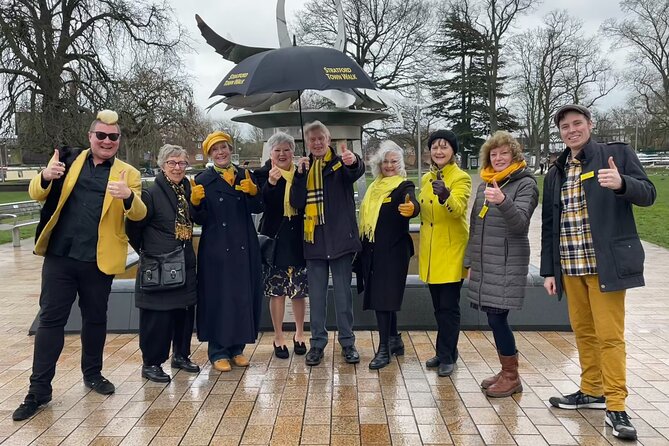
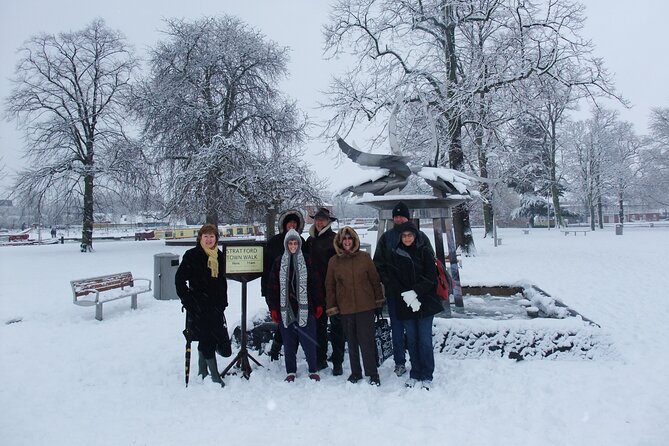
Your walk begins at the Swan Water Fountain in Bancroft Gardens on Waterside (20 Waterside, Stratford-upon-Avon, CV37 6BA). The guide stands near a lamppost with a yellow sign for the company, and they wear a flash of yellow so you can spot them quickly.
That sounds minor, but it matters in Stratford. If you arrive a few minutes late, it’s easy to lose the group, and you don’t want a wandering start eating into your 2-hour window. I’d show up early, snap a photo of the lamppost area, and then wait for the guide.
The tour route can vary, and the guide can tell you where it ends. It does finish in a different location from where you start, so before you walk away from the meeting spot, ask the guide where your group will exit.
More England on foot, brolly optional:

The Full Route on Foot: What You See, What It Means, and What Costs Extra
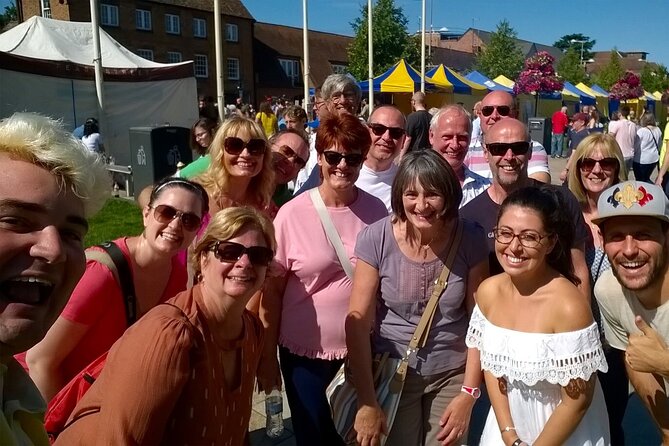
The tour is structured as a sequence of focused photo-and-story moments. Many stops include only an outside look, which keeps the walking tour moving but also means you may want to buy separate entry if you want more.
Stop 1: The Swan Water Fountain (10 minutes)
This is your “reset button.” You’re starting near the River Avon area, and it sets the tone for a town tour that blends literature with place. You also get a quick feel for the rhythm of the route: straight-forward walking, frequent small pauses, and plenty of chances to listen.
The only drawback here is that you’re early on, so it can feel like you’re warming up. Once you hit the Shakespeare sites, the pace really locks in.
Stop 2: Shakespeare’s Birthplace on Henley Street (10 minutes, entry not included)
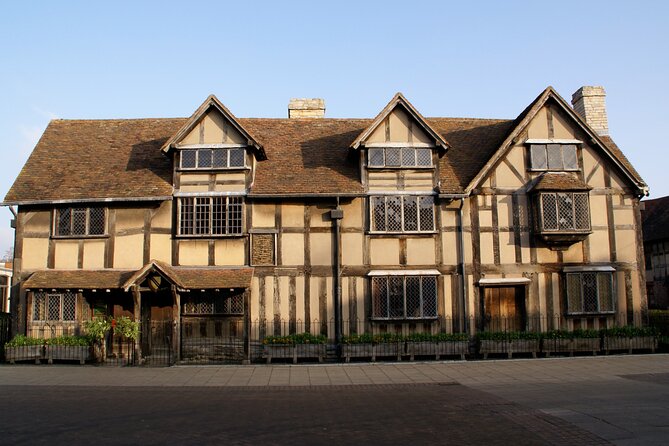
This is a gorgeous 16th-century half-timbered building. It’s the family home of John and Mary Shakespeare, and it’s where William Shakespeare was born in 1564.
What I like is that the guide connects business, family, and childhood into one thread. John Shakespeare established his glove-making business here, and William grew up in this house. After his marriage, William lived with his wife Anne Hathaway, and your guide ties those family details back to the Tudor-era setting.
Plan for this: you see and hear the stories, but you do not get included admission. If you want to go inside, the tour offers discounts for Stratford Town Walk customers, including options to visit Shakespeare’s Birthplace before or after the walk.
Stop 3: Shakespeare’s New Place (10 minutes, entry not included)
William Shakespeare bought New Place when he was 33 and lived there with his family until he died at 52. You stand near the magnificent gates and get a mental picture of how enormous the house was.
The best part is the demolition angle. Your guide explains why it was demolished in 1759, which turns the site into more than a postcard. You start thinking about how Stratford kept changing, even as Shakespeare’s fame kept growing.
Drawback: it’s mostly exterior time. If you want the full interpretive experience inside, you’ll need to plan that separately.
Also on in Stratford upon Avon, no fuss
- Cotswolds in a Day Tour from Moreton-in-Marsh / Stratford-on-Avon★ 5.0 · 1,216 reviews
- Shakespeare Distillery Tour – 1pm Ticket★ 5.0 · 598 reviews
- City Sightseeing Stratford-upon-Avon Hop-On Hop-Off Bus Tour★ 4.0 · 254 reviews
- Shakespeare’s Schoolroom & Guildhall Entry Ticket and Tour★ 5.0 · 232 reviews
Stop 4: Hall’s Croft (10 minutes, entry not included)
Hall’s Croft is the home of John Hall, a physician who married Shakespeare’s eldest daughter Susanna. The building’s Jacobean feel gives you that sense of Shakespeare’s family living in a real social world, not just a museum label.
The guide’s stories focus on medieval medical cures. It’s a surprising pivot from playwright talk, and I like it because it broadens Shakespeare beyond plays into daily life, including how people understood health and treatment.
As with many stops, you’ll mostly be looking from the outside. If you want a deeper visit, entry is separate.
Stop 5: Holy Trinity Church by the River Avon (10 minutes, entry not included)
Holy Trinity Church is one of the most visited parish churches in England. You approach along an avenue of lime trees, and the setting right by the River Avon adds an extra layer of quiet to the walking rhythm.
This is where Shakespeare was baptized, worshipped, and later buried within the chancel. Dating information matters here too: the church dates back to 1210, so it feels much older than the Shakespeare narrative you just learned.
Again, no included admission. If you’re the type who wants to see interiors and graves more closely, you’ll want to add a separate visit.
Stop 6: The Guild Chapel (10 minutes, entry not included)
The Guild Chapel dates back to 1269 and links to the Guild of the Holy Cross, a major social and religious organization in Stratford.
What makes this stop special is the mention of rare medieval wall paintings in Europe. Even without included entry, the stop helps you understand why this building gets attention. It’s not only “old stone,” it’s a place where painted stories and community life connected.
If you care about medieval art, you’ll likely want to budget time for a separate visit.
Stop 7: Shakespeare’s Schoolroom and the Guildhall (5 minutes, entry not included)
This stop is short but packed. Shakespeare’s Schoolroom is a half-timbered building dating to the 1400s. It’s tied to where Shakespeare was educated and inspired to become a playwright.
The school was known as the King’s New School and is now King Edward VI Grammar School (K.E.S.). Below the schoolroom is the Guildhall, and in 1553 it served as the headquarters of Stratford Borough Council. The guide frames it as a civic heart for over 400 years.
Drawback: only a brief stop. If you want the inside context, you’ll need extra time and tickets.
Stops 8 to 10: Royal Shakespeare Theatre, Swan Theatre, and The Other Place
These theatre-focused stops are where the tour gets especially rewarding for modern culture fans. Stratford isn’t just the past, and you’ll feel that here.
Stop 8: Royal Shakespeare Theatre (5 minutes, entry not included)
The Royal Shakespeare Theatre traces back to 1932, designed by Elisabeth Scott, who won a competition for her design. It replaced the 1879 Shakespeare Memorial Theatre, which was destroyed by a fire in 1926.
Even if you don’t plan to see a show on the day, the outside context helps. You learn that the Royal Shakespeare Company is based here, bringing Shakespeare to visitors from all over the world.
Stop 9: Swan Theatre (5 minutes, entry not included)
The Swan Theatre sits on the site of the 1879 Memorial Theatre. Only the library and art gallery survived the 1926 fire, and later, in 1986, fundraising and benefactors allowed the Swan Theatre to open inside the original red-brick gothic facade.
I like this contrast. The theatre world here is built on adaptation, not just nostalgia.
Stop 10: The Other Place (5 minutes, entry not included)
The story of The Other Place starts in the 1970s as a corrugated tin shed used for rehearsal and studio work for new and experimental theatre. It later reopened in 2006 as The Courtyard Theatre.
At one point it seated 1000 people and served as a temporary theatre while the Royal Shakespeare Theatre and Swan Theatres were transformed. Now it’s a flexible 200-seat theatre space with rehearsal rooms and costume storage.
This stop gives you a sense of how Stratford has kept Shakespeare alive through experimentation, not only classics on a stage.
Stop 11: Town Hall Stratford-upon-Avon (5 minutes, entry not included)
The Town Hall is a Grade II listed building dating to the mid 1700s, on the site of the old Market House. During the English Civil War, the Market House was used as a munitions store.
You then get the gunpowder explosion story, which damaged the building badly. The current structure was completed in 1767 and opened in 1769 by actor David Garrick, with a Shakespeare statue presented at the opening.
If you like urban history and how towns govern themselves, this stop rewards you for paying attention.
Stop 12: High Street and The Cage (5 minutes, entry not included)
This is the market intersection story. In the 1400s, a High Cross sat at the junction of High Street and Bridge Street to show where the market took place.
There’s also the small building sometimes called The Cage on the corner of High Street and Bridge Street. The town jail was located beneath it. Your guide ties in family history here too, including Judith Shakespeare and her husband Thomas Quiney, a vintner.
It’s a quick stop, but it helps you see the street grid as part of life, not just scenery.
Stop 13: The Almshouses, Guild Cottages (2 minutes, entry not included)
These almshouses, known as The Guild Cottages, were built in the 1500s by the Guild of the Holy Cross for the aged and infirm of its members. Municipal Charities of Stratford-upon-Avon manage the properties.
Even if you can’t go inside, the timing here is telling. The tour keeps moving, but it doesn’t forget community care and social structures.
Stop 14: Harvard House and John Harvard (2 minutes, entry not included)
Harvard House was built in 1596 by Thomas Rogers. It has an elaborately carved facade, and it’s described as the richest in town, tied to Rogers’s wealth and status.
The connection to Harvard University comes through family links. Rogers’s daughter Katherine married into the Harvard family, and their son John Harvard emigrated to America and established the library around which Harvard University was built.
If you’ve never heard this link before, it’s one of those moments that makes the walk feel bigger than Stratford.
Extra stops that add local color beyond the main Shakespeare trail
The route also includes additional landmarks that you might not think to prioritize on your own.
- A site tied to Marie Corelli, a famous Victorian novelist and Stratford resident known as Shakespeare’s Champion and also noted as a conservationist.
- The Gower Memorial, created in 1888 by Lord Ronald Gower along the main road into town near Clopton Bridge, with the Royal Shakespeare Theatre visible behind. The memorial features a Shakespeare statue with characters including Hamlet, Prince Hal, Lady Macbeth, and Falstaff, and you can see it from Bancroft Gardens.
- A look at the Birmingham to Stratford Canal, opened in 1816 for transporting goods like coal and wood. The canal terminates in a basin with a lock for access to the River Avon, and today it’s mostly used for holiday makers.
- A stop at Rother Market, the weekly market site held Fridays and Saturdays.
These additions help you understand the town as a working place, not only a literary stage.
Entry Tickets and Discounts: How to Plan Your Spend Smart
Most of the major “Shakespeare houses” and similar attractions are not included in the tour price. That’s not a trick, it’s part of how the walking tour keeps things efficient and affordable.
Here’s the practical way to think about it:
- The walking tour gives you context outside, with names, dates, and stories you can connect to when you do buy entry.
- If you plan to visit inside museums or houses, you should expect separate admissions.
- The tour offers discounts for Shakespeare-related attractions, including Shakespeare’s Birthplace if you visit before or after the tour.
So you can turn this into a smart two-step day. Start with the walk to learn what you care about most, then spend your money on the specific indoor sites that match your interests.
If you’re on a tight budget, you can also do a very “outside-first” approach. Focus on the church and key facades during the walk, then pick only one or two indoor locations to upgrade later.
The Guide Factor: What the Best Tours Feel Like
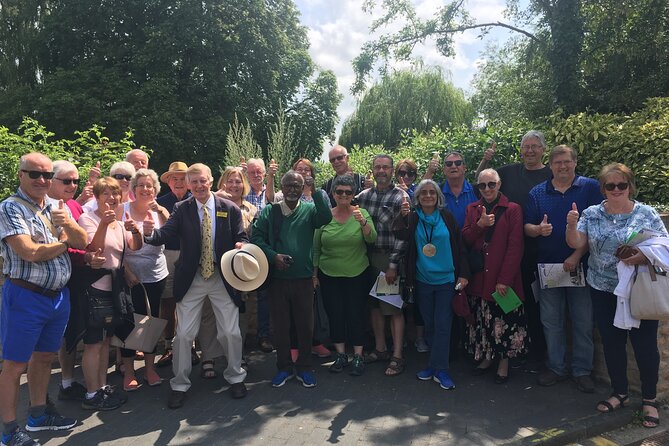
The tour is led by local professional guides, and names like John, Georgina, Grace, Josh, Bobby, Jan, and Jane have shown up in recent groups. What they seem to share is a talent for making Stratford readable, not just recitable.
I like that the guide wears a visible flash of yellow at the start. It feels organized, and it reduces that awkward early-minute chaos.
Also, the storytelling format matters. You don’t just get facts. You get family links and town details tied together, so you don’t forget what you saw ten minutes ago.
Timing Choices: Morning vs Afternoon and Building a Full Stratford Day
A big plus is that you can choose a morning or afternoon tour. That simple option helps you avoid the “one rigid plan” problem.
If you’re trying to pack the day:
- Morning tour, then use the afternoon for the attractions you want to enter.
- Afternoon tour, then schedule morning visits before your walk next day if you’re staying longer.
Either way, the walk is short enough to fit around other priorities. You also end in a different location, which can be useful if you want to continue exploring on foot after the tour.
Booked in advance is common. The tour is typically booked about 14 days ahead on average, so if you’re traveling in peak season, lock in your time slot earlier rather than waiting.
Who This Walking Tour Is Best For
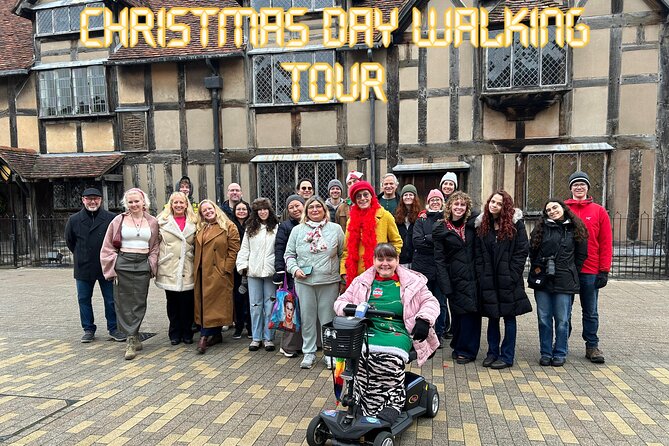
This is ideal if you want a first-time Stratford hit that doesn’t trap you inside ticket lines all day.
It fits well for:
- Shakespeare fans who want the family and civic story, not only the biggest photo spots
- Architecture and street-detail lovers, since you’re stopping at buildings with real eras behind them
- People who like theatre, because the Royal Shakespeare Theatre, Swan Theatre, and The Other Place make Shakespeare feel alive today
- Visitors who want a route through parts of town where cars cannot go, meaning a more authentic walking feel
It’s not the best choice if standing and walking are hard for you. The tour is designed for mobility people, and the operator explicitly notes it’s not recommended for those with difficulty standing or walking.
Should You Book This $16.67 Stratford Walk?
Book it if you want a smart, story-driven orientation to Stratford-upon-Avon in about two hours. The combination of major Shakespeare landmarks, theatre sites, and town details like the canal and market gives you a fuller picture than a single “houses-only” plan.
Skip or reconsider if you’re only interested in inside museum visits. Since entry to many stops is not included, you’d likely end up paying extra anyway, and you might prefer a tour that includes timed entry.
If you can do both, best approach is simple: take the walk for context, then choose one or two indoor sites after. You’ll know exactly what you want to see, and you’ll spend your money where it counts.
FAQ
How long is the Stratford Town Walking Tour?
The tour lasts about 1 hour 45 minutes to 2 hours.
What does the tour cost?
The price is $16.67 per person.
Where does the tour start?
The meeting point is the Swan Water Fountain, 20 Waterside, Stratford-upon-Avon, CV37 6BA, UK.
Does the tour end at the same place it starts?
No. The tour ends in a different location. The guide can tell you the ending place.
Is the tour guided, and what language is it in?
Yes, it includes a local professional tour guide, and it is offered in English.
Is entry to Shakespeare’s houses included?
No. Entry to Shakespeare’s Birthplace and other attractions listed on the route is not included.
Are there discounts for tour participants?
Yes. Discounts are offered on attractions including Shakespeare’s houses. A discount is specifically noted for Shakespeare’s Birthplace if you visit before or after the tour.
How big is the group?
The tour has a maximum of 25 travelers.
Is this tour suitable for people with limited walking ability?
It is not recommended for travelers who have difficulty standing or walking.
Are service animals allowed?
Yes, service animals are allowed.
Latest to join the queue for Stratford upon Avon






Walking Tours, compared.
Oxford University Walking Tour With University Alumni Guide
Read our review →
Tour for Muggles The Ultimate Harry Potter Walking Tour in London
Read our review →
Cambridge University Walking Tour by Alumni™ Kings College Option
Read our review →
Blackbeard to Banksy – The Ultimate Walking Tour of Bristol
Read our review →
Air Raid Shelter + St. Nicholas Market Walking Tour
Read our review →
Walking Tour of Bath with Blue Badge Tourist Guide
Read our review →
Changing of the Guard Guided Walking Tour in London
Read our review →
Shadows of York: Ghost Walk and Horrible History.
Read our review →Browse the lists this tour appears in