
Reviewed · CITY TOURS
Ancient Hidden Gems in the City of London
City of London has a talent for surprise. This easy 2-hour walk threads Roman leftovers, medieval fragments, and post-bomb discoveries through real streets, with free-to-enter stops that keep the pace friendly. I especially like the storytelling focus that turns familiar landmarks into clear moments of cause and effect, all in one simple booking.
One thing to consider: most stops are quick look-and-learn stops, so if you want long, sit-down museum time, you may feel a bit rushed.
In This Review
- Key highlights you’ll feel on the walk
- Why this 2-hour City of London route feels like time travel
- From 101 Moorgate to St. Alphage London Wall: the Roman thread starts early
- St Alban Wood Street Church Tower: Wren meets the future (and it makes sense)
- Noble Street and the surprise of ruins after WW2
- Postman’s Park and the Watts memorial: where the walk slows down for meaning
- Old Bailey, Christchurch shell, and the way one building becomes a story of loss and survival
- Smithfield Market: why a meat market matters to British history
- St Bartholomew the Great: the 900-year-old church outside, then inside
- Price and logistics: is $27.46 worth it?
- Who should book this walk (and who might want a different plan)
- Final call: should you book?
- FAQ
- How long is the tour?
- How much does it cost?
- What time does the tour start?
- Where do I meet the tour?
- Where does the tour end?
- Is the tour in English?
- Is the tour wheelchair and stroller accessible?
- Do I need to print tickets?
- Is admission charged at the stops?
- What is the cancellation policy?
Key highlights you’ll feel on the walk
- Tight, 2-hour route that covers a lot of ground without needing a big plan
- Roman to Wren to modern architecture seen in the same field of view
- WW2 bomb-era context that explains why some ruins show up where they do
- Watts memorial time at Postman’s Park, a pause that adds meaning
- St Bartholomew the Great inside visit after you take in the 900-year-old outside
Why this 2-hour City of London route feels like time travel
I love it when a walking tour does not just point at old buildings. You want it to help you understand what you are looking at, and why it exists right there, right now. This one is built for that. You move through the City of London, then suddenly the past starts answering your questions.
The best part is how the route connects layers of time without requiring you to switch tours. Roman-built features show up next to medieval church remains, then you get explanations for how the bomb damage of World War II exposed Roman ruins. That link, the idea that history gets uncovered by later events, is what makes the walk feel like a living timeline rather than a list of stops.
I also like the practical design for a wide range of people. It is wheelchair and stroller accessible, and it runs as a focused stroll with short stops rather than a long slog. The group stays small, with a maximum of 25, so the guide can keep moving and still answer questions.
If you are the type who likes history but hates doing homework, you should feel at home here. Even if you are not a hardcore architecture person, you will get the meaning, and you will get it fast.
Also on in London, no fuss


From 101 Moorgate to St. Alphage London Wall: the Roman thread starts early
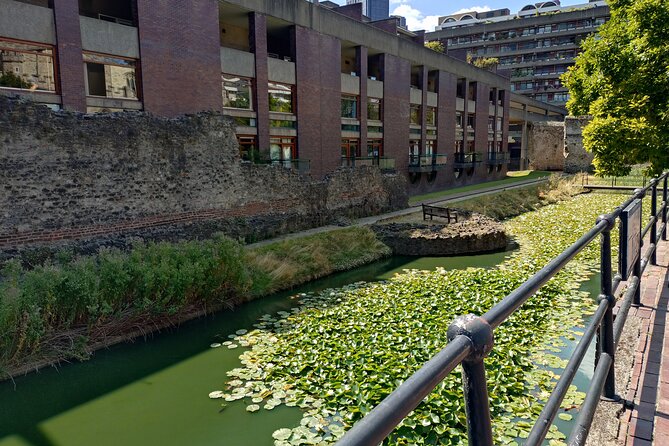
You begin at 101 Moorgate at 11:00 am, then you walk your way into one of London’s oldest storylines. The first stop is St. Alphage London Wall. You will see medieval church remains, plus a section of the ancient London wall that was originally built by the Romans.
That pairing matters. Many London sights sit in isolation, like separate chapters. Here, the tour is trying to show you the continuity of the city. Roman defenses become a physical spine, and later buildings grow around that inherited structure. Even with a quick stop, this sets the tone for the whole walk, because you start noticing how one era leaves shapes that later eras reuse.
You get only about five minutes here, so come with your eyes ready. Look for the wall section and then look again for how the church remains relate to it. If you only glance once, you will miss the whole point: the Romans built, medieval London adapted, and your street-level view is shaped by both.
Practical tip: wear comfortable shoes. The stops are short, so the walking is where you do your thinking. Let your legs warm up early, then slow down for each stop when you reach it.
St Alban Wood Street Church Tower: Wren meets the future (and it makes sense)

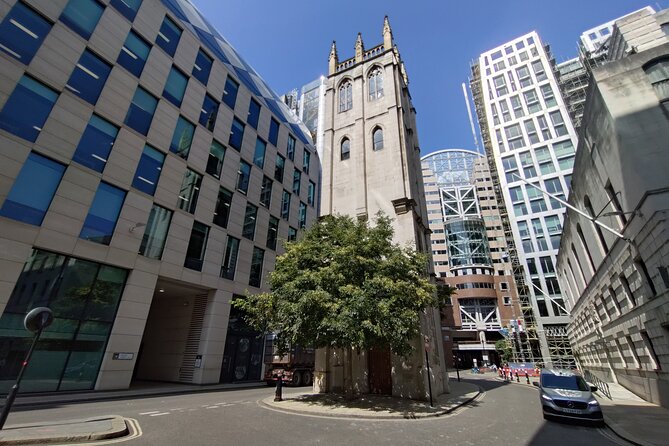
Next comes St Alban Wood Street Church Tower. This stop gives you a powerful contrast in one view: you will see the surviving tower of St Alban’s, built by Sir Christopher Wren, set against surrounding modern architecture by Norman Foster, Lord Rogers, and Terry Farrell.
This is the kind of contrast that can feel random if you do not have a guide to make it legible. With the explanation, it becomes a lesson in how London builds upward and outward over time. The old structure is still there, standing tall, while the newer buildings tell you what the city chose to value next.
Also, this is a stop with a strong visual payoff. Even if you do not remember every name, you will remember the moment when old stone and modern design share the same frame. That is not just aesthetic. It helps you understand London as a place where the past is not erased. It is repurposed into the skyline.
Again, you only get about five minutes. Use that time to look broadly first, then focus on the tower itself. When the guide explains the tower’s survival and the modern context around it, the whole scene clicks.
Noble Street and the surprise of ruins after WW2
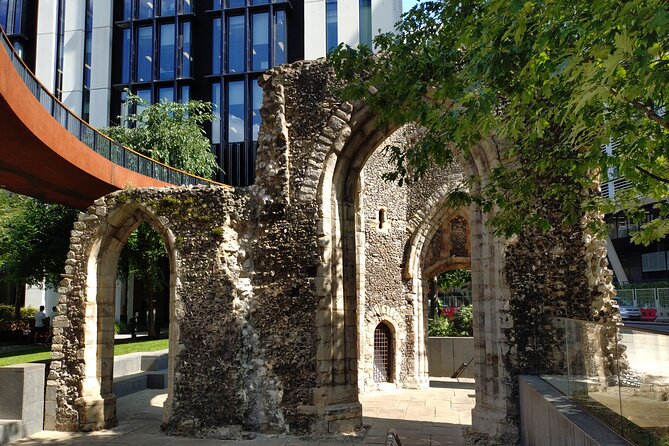
Now the story turns sharper. At Noble Street, you will see Roman ruins that were discovered after bombing in World War II devastated the area.
This is one of those details that changes how you walk through cities. It is easy to assume that archaeology just happens by accident. Here you learn a harder, more honest truth: war destroys, and destruction can expose what was previously buried. It is sobering context, but it also gives you a clearer reason for why you can find Roman remnants in a setting that looks much more modern.
The stop itself is brief, about five minutes. So keep your expectations realistic. You are not walking through a full excavation site with interpretive panels. Instead, you are seeing the idea of discovery made physical. The value is in the explanation that connects the ruins to the postwar moment when they were revealed.
If you like history that explains cause and effect, you will appreciate this part. It is less about dates, more about how events reshape what we can see.
Postman’s Park and the Watts memorial: where the walk slows down for meaning
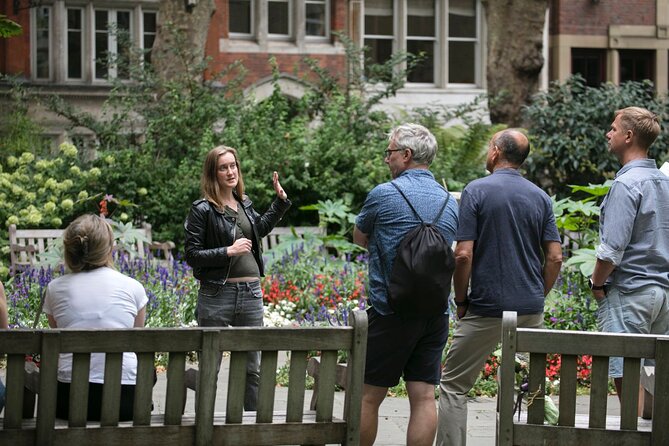
Postman’s Park is where the tone becomes more reflective. You will spend time in the park viewing the Watts memorial to those who gave their lives for others, and you will discuss the history of the park.
This stop is not just a visual breather. It changes how you feel about the rest of the walk, because it shifts from surviving buildings and exposed ruins to human choices and remembrance. The memorial is specifically tied to selfless sacrifice, and the tour uses the park setting to slow the pace a bit.
You get about five minutes here. That might sound short, but the park moment works because you are not moving constantly. You can stand, read, and let the guide’s explanation frame what you are seeing.
If you are traveling with kids, this kind of stop can help them connect better than another photo stop. It is also a meaningful break if you want something less purely architectural.
While the kettle’s on in London:
- Stonehenge, Windsor Castle and Bath with Pub Lunch in Lacock★ 4.5 · 7,402 reviews
- Tower of London and Crown Jewels Exhibition Ticket★ 4.5 · 6,677 reviews
- Thorpe Park Admission Ticket★ 4.0 · 5,915 reviews
- Stonehenge, Windsor Castle and Bath Full Day Guided Tour★ 4.5 · 5,346 reviews
Old Bailey, Christchurch shell, and the way one building becomes a story of loss and survival
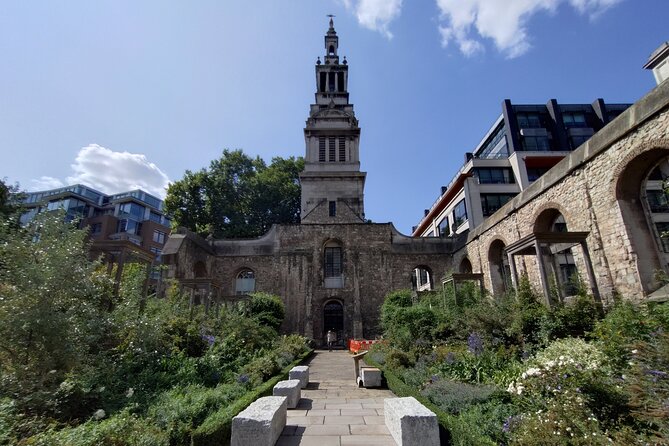
From Postman’s Park, you move to the Old Bailey area and visit the garden within the shell of Christchurch, another bombing victim of World War II. You will also discuss the Old Bailey.
This is a smart pairing: the tour connects a major legal landmark area with the physical remnants of a destroyed church shell. Even with a short stop of about five minutes, you get an interpretive angle. The guide is showing you how the city keeps functioning while parts of it bear visible scars.
The “shell” idea is important. It means something survived even if the building did not. So instead of just seeing ruins, you see continuity, the way communities carry on, and the way physical emptiness can still hold meaning.
If you have ever walked past landmarks and thought, What happened here, this is the moment when that question gets answered. And if you are a history fan, this is the part that makes the walking tour feel like more than a sight list.
Smithfield Market: why a meat market matters to British history
Next is Smithfield Market, where you hear about the 1,000 year old meat market and the historical events that took place here that shaped British history.
This stop is another quick one, about five minutes, but it is loaded. The idea that one market location can influence the bigger story of Britain is exactly the kind of thing that makes the City of London feel worth your attention.
Markets are not just places to buy food. They are power centers. They attract commerce, decisions, and public life. Even if you do not leave with a new hobby for meats, you will come away understanding why historians keep returning to places like Smithfield.
Practical thought: if you like to photograph architecture, keep your camera ready here too. Market spaces often combine older layouts with newer activity, and the guide will help you look past the obvious.
St Bartholomew the Great: the 900-year-old church outside, then inside
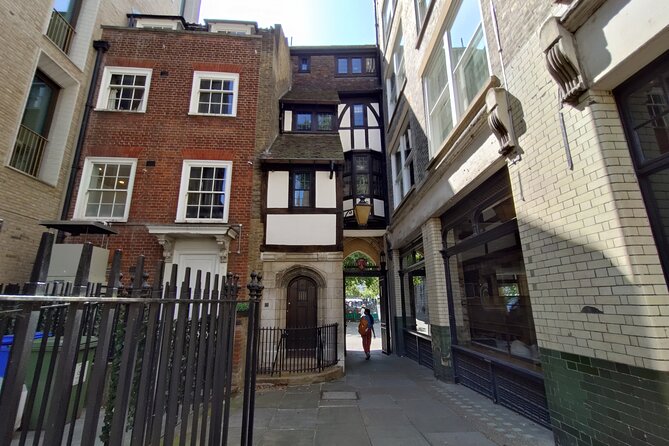
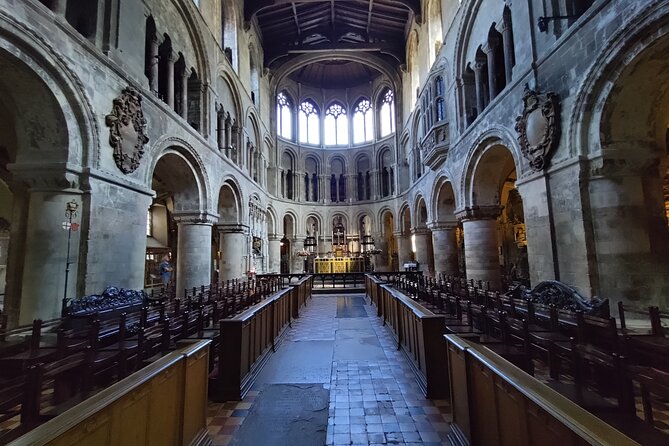
Your final stop is Church of St. Bartholomew the Great. You will hear about the incredible 900 year old church outside, and then go inside for a visit.
This is the one stop where the time expands. You get about 20 minutes, which is a big deal on a tour that otherwise runs on quick moments. It gives you time to slow down and take the building in as a place of worship and a piece of London that has clearly lasted.
If you tend to rush through churches, this is a good chance to do it the right way. Look at the outside first with the guide’s framing, then step inside and compare what you notice. The contrast between exterior age and interior experience is often what makes a church stop memorable, and here you get that built-in sequence.
This stop is also where your route pays off. Earlier, you learned about Romans, medieval remains, and postwar discovery. Ending at a church that is roughly 900 years old gives your walking timeline a strong anchor.
Price and logistics: is $27.46 worth it?
The price is $27.46 per person, and the tour runs about 2 hours. That is not the kind of price where you are paying mainly for transport or convenience. You are paying for a guided route that compresses multiple historical sites into a workable plan.
Here is why that matters: the City of London can be confusing on your own. You might see a wall section, a church tower, and a park memorial, but you might not connect them into a clear narrative. This tour is designed to do that connection for you, and the 2-hour format keeps the learning steady rather than exhausting.
Another value point: many of the sights are marked as admission ticket free, including the church stop. That makes the tour feel lower-risk. You are not budgeting extra entry fees for each stop, so your money is going toward interpretation and route guidance.
Group size is capped at 25, which usually means you can keep up without getting steamrolled in a crowd. Also, you get a mobile ticket and the tour is in English, so you can focus on the streets and not on last-minute logistics.
If you want a history-focused experience that still feels light and doable, this is priced like a smart add-on to a day in London.
Who should book this walk (and who might want a different plan)
I think this tour fits best if you like history but want it explained clearly. It is ideal for you if you are a keen history buff, but you also enjoy stories, not just facts. The walk is built around short stops with meaning attached, so it works well even if your attention span is not measured in hours.
It is also a good choice if you travel with a stroller or you need wheelchair access. The tour explicitly lists wheelchair and stroller accessibility, and it is near public transportation. It is even set up to allow service animals.
You might want to choose a different experience if you prefer deep museum time. This is not a two-hour lecture. It is a guided walk, and the payoff is seeing many places through an interpretive lens. If you want long, quiet downtime, plan your day so you have space after the walk to sit and process.
Final call: should you book?
Yes, I would book it if you want a fast, well-explained way to understand why the City of London looks the way it does. The mix of Roman remnants, Wren’s tower, WW2-related discoveries, and the Watts memorial creates a route that feels coherent, not random.
It is also a strong option if you want to share London with someone who usually says they are not into history. The guide-led storytelling approach, especially the pacing and the visible contrasts, is the kind of thing that turns interest on quickly.
If you are here for architecture, remembrance, and the way cities change, this walk gives you a lot for the money in just two hours. Book it, then spend the rest of the day noticing what the tour taught you to look for.
FAQ
How long is the tour?
The tour lasts about 2 hours.
How much does it cost?
It costs $27.46 per person.
What time does the tour start?
The start time is 11:00 am.
Where do I meet the tour?
You meet at 101 Moorgate, London EC2Y 9AA, UK.
Where does the tour end?
The tour ends at St Bartholomew the Great, W Smithfield, Barbican, London EC1A 9DS, UK.
Is the tour in English?
Yes, the tour is offered in English.
Is the tour wheelchair and stroller accessible?
Yes, it is wheelchair and stroller accessible.
Do I need to print tickets?
You get a mobile ticket.
Is admission charged at the stops?
Each listed stop is marked as admission ticket free.
What is the cancellation policy?
You can cancel for a full refund up to 24 hours before the experience’s start time. If you cancel less than 24 hours before, the amount paid will not be refunded.
Latest to join the queue for London







City Tours, compared.


Liverpool City Sights Hop On Hop Off City Tour – 24hr Ticket
Read our review →
1.5-hour Oxford City and University Walking Tour
Read our review →
City Sightseeing London Hop-On Hop-Off Bus Tour & Bookable Extras
Read our review →

City Sightseeing Oxford Hop-On Hop-Off Bus Tour
Read our review →
Browse the lists this tour appears in