
Reviewed · MUSEUMS
The British Museum: a highlights tour with a TV historian
History reads like a thriller here. This 3-hour British Museum highlights tour takes you through the big objects, then tells you why they matter, including how they ended up in London. You also get a private-guide feel, not a herd tour, with stories that can make even mummies and disputed acquisitions feel clear.
I especially love the way the guide turns writing systems into something you can understand, with Rosetta Stone decoding as the star moment. I also like the focus on variety, from Egypt and Assyria to Aztec, Benin, and China, so you leave with a map of the museum instead of a pile of random facts. One consideration: museum entry is free, but you must book your own timed ticket, and you should plan for a buffer of about 30 minutes to get in.
In This Review
- Key things you will notice on this tour
- Entering the British Museum Reading Room on a tight 11:00 schedule
- Why a historian-guide makes the museum make sense fast
- Rosetta Stone and the moment writing becomes readable
- Egypt, Assyria, and the artifacts behind power
- Cuneiform translation, the world’s oldest epic, and reading ancient voices
- Sutton Hoo, an oldest library moment, and how civilization sounds on paper
- Elgin Marbles and Parthenon sculptures, where acquisition stories matter
- Objects across continents: Benin bronzes, Lewis Chess, and Celtic jewelry
- Easter Island statue and the Shiva statue from India, plus why belief objects travel
- Pacing, breaks, and how the tour stays fun
- Price and value when the museum admission is free
- Who should book this British Museum highlights tour
- Should you book it
- FAQ
- How long is the British Museum highlights tour?
- Where do I meet for the tour?
- What time does the tour start?
- Is this tour private?
- Is the museum admission free?
- What language is the tour offered in?
- Are service animals allowed, and is it near public transportation?
- What is the cancellation policy?
Key things you will notice on this tour
- A TV historian style of storytelling that makes the artifacts connect to real life, not just timelines
- Private group pace, so you can stop for questions and move when the galleries are manageable
- Decoding highlights like Rosetta Stone and cuneiform translation, explained in plain language
- Acquisition talk built in, including the stories behind major pieces like the Elgin Marbles
- Kid-friendly pop culture framing, including Harry Potter and Hollywood references when needed
Entering the British Museum Reading Room on a tight 11:00 schedule
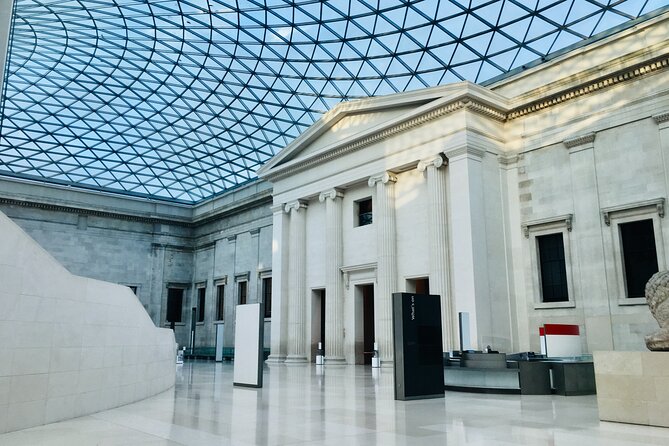
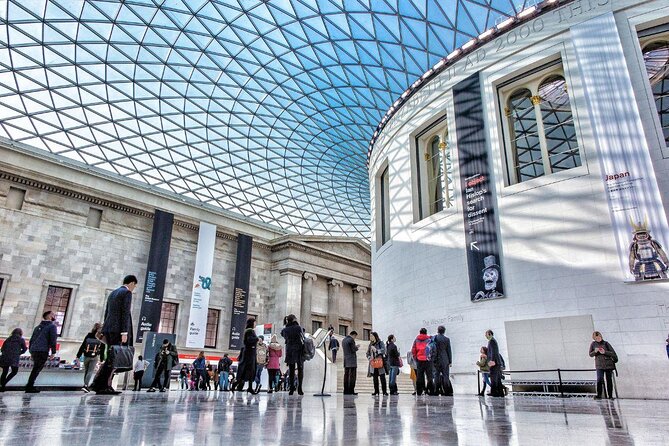
This tour starts at the British Museum Reading Room on Great Russell St. The scheduled start time is 11:00 am, and the tour runs about 3 hours. You will end back inside the museum area near the Mummies gallery, so it is a smooth loop rather than a point-to-point shuffle.
The most practical tip is timing. Even though the museum’s basic admission is free, you still need a timed entry ticket you book on the British Museum website. I suggest building in a solid buffer, because it can take around 30 minutes to get inside, especially if you arrive late or your entry window is earlier than you think.
Also, this is a private tour, meaning only your group joins. That matters in a place as big as the British Museum, because you can ask follow-up questions without the usual pressure of keeping pace for everyone else. Service animals are allowed, and the meeting point is near public transportation, which makes the start feel easier than it could be in London traffic.
More free halls and paid exhibitions:
Why a historian-guide makes the museum make sense fast
A museum this size can overwhelm you. This tour solves that by using a guide who knows the museum deeply and can explain how to look at objects, not just what they are. The big difference is that you are not wandering alone, trying to guess what is important first.
One guide named Loona came up in the experience you shared. The standout theme was his firsthand museum experience and his ability to turn behind-the-scenes details into something fun. There was even mention of him supervising sleepovers with the mummies, which tells you the style: he is comfortable mixing serious context with human stories.
The tone is also flexible. If you have kids who are not instantly into history, the guide can bring it to life with Harry Potter references, plus comparisons to Hollywood and contemporary life. That is not just a gimmick. It is a way to help younger minds grab the meaning before the details pile on.
Rosetta Stone and the moment writing becomes readable
The first “wow” story is the one you have heard about for years, but here it is explained in a way you can actually use. You will see the Rosetta Stone, and you will learn how hieroglyphs were deciphered. The point is not memorizing alphabets. It is understanding why translation was possible at all.
You will also get a sense for what makes writing so powerful in archaeology and history. When you can read, you can verify, compare, and date, instead of guessing. Even if your background is zero, you will leave knowing what changes when scholars figure out the system behind the symbols.
If you like the idea of “How did anyone ever do this?” this is your stop. The tour treats it like a real detective story, not a textbook diagram. It also sets the tone for everything else, because many galleries you will see next connect to records, law, trade, and empire documents.
Egypt, Assyria, and the artifacts behind power
After the Rosetta Stone lead-in, you move through a chain of objects tied to rule, warfare, belief, and display. You will see the bust of Rameses II, which is a strong example of how portraits and royal imagery worked as political technology. Instead of reading this as only art, you learn to look for messaging, like authority, continuity, and divine association.
You will also encounter an Assyrian war machine type of display, where the museum’s collections show how empires documented violence and control. The practical benefit of a guided route here is that you do not just skim the reliefs. You get the context for what you are looking at and why it was worth carving.
Along the way, the tour builds variety quickly. You will also see Mayan carvings and Aztec jewellery worn by Montezuma. These are not placed there as random “exotics.” The guide frames them as pieces of cultural identity and political status, which makes them easier to respect, and easier to understand.
And yes, you will get pop culture style curveballs too. One of the promised moments is fakes, including crystal skulls and mermaids. That section matters more than it sounds, because it teaches you how to spot hype, how objects gain fame, and how museums handle misinformation and authenticity.
Cuneiform translation, the world’s oldest epic, and reading ancient voices
The tour does something smart with languages: it returns to translation more than once. You will see cuneiform, and you will learn how it was translated. That ties directly into why the Rosetta Stone story is so valuable. Different scripts, different paths, same human need to communicate across time.
Then the route brings in story form. You will be shown the world’s oldest epic story on display. The payoff is realizing that literature is not a modern invention. You see how ancient societies used narrative to explain values, conflicts, and identity.
This section is also where the tour can click for different ages. For kids, a guided translation story can feel like magic. For adults, it becomes a reminder that scholarship is work, and breakthroughs have consequences for how we interpret the past.
Also on in London, no fuss
- Stonehenge, Windsor Castle, and Bath from London★ 4.5 · 18,662 reviews
- London Big Bus Hop-On Hop-Off Tour with Optional River Cruise★ 3.5 · 10,803 reviews
- London Small Group Tour of Historical Pubs★ 5.0 · 10,422 reviews
- Stonehenge, Windsor Castle and Bath with Pub Lunch in Lacock★ 4.5 · 7,402 reviews
Sutton Hoo, an oldest library moment, and how civilization sounds on paper
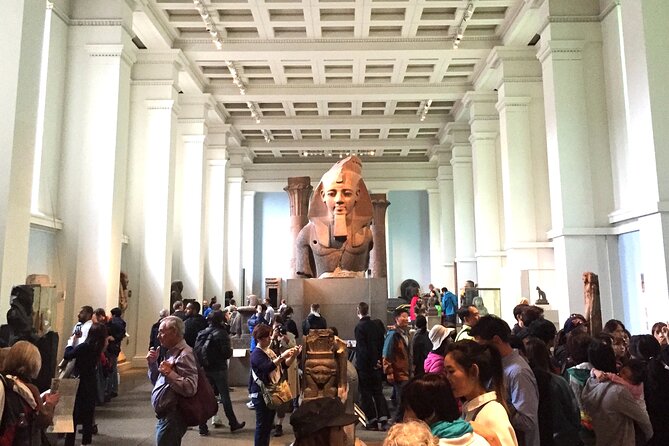
One of the more charming parts of the route is how it includes Britain and everyday cultural artifacts. You will see Anglo Saxon Sutton Hoo, which gives you a window into a period that often gets skipped in “big museum” highlights. It is a good contrast to the grand imperial monuments, because it reminds you that history is also material culture and craftsmanship.
You will also stop for an oldest library moment. British Museum objects connected to early recorded learning are not just impressive because they are old. They matter because they show how societies stored knowledge and preserved it long enough for people like us to interpret it.
Then you will encounter the first ever declaration of human rights on display, framed in the way the guide explains its significance. Even if you know the general concept already, this is the practical version: you see the artifact in context and understand what people point to when they call it a milestone.
Elgin Marbles and Parthenon sculptures, where acquisition stories matter
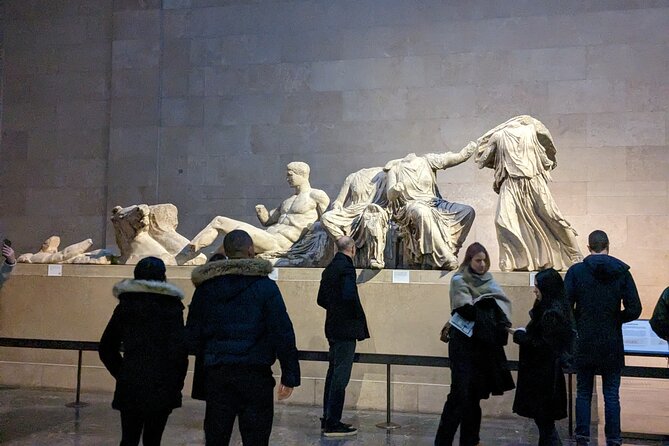
Major classics are part of this highlights tour. You will see Parthenon Sculptures and Elgin Marbles. The value here is not only the art and scale. It is the way the guide includes the stories behind acquisition.
This is where a good guide earns their ticket. The museum holds objects with complicated routes into European collections. This tour is designed to talk through those routes instead of treating them like background noise. That helps you make sense of why these pieces are both admired and debated.
If you care about ethics, you will likely appreciate that the acquisition story is explicitly part of what you hear. You can walk away with more than admiration. You can also have a clearer sense of what questions historians, museums, and the public wrestle with.
Objects across continents: Benin bronzes, Lewis Chess, and Celtic jewelry
The route keeps moving with themed stops that broaden your mental map. You will see Benin Bronzes, Celtic jewellery, and the Lewis Chess pieces. These three in particular give you a nice range: ritual and symbolism, craft and identity, play and thought.
Lewis Chess pieces are a great “pause and look” object because you can see form and function at once. The guide’s value here is that you do not just notice them as medieval curiosities. You understand how such objects carried meaning in their time.
Celtic jewellery works similarly. Without context, jewellery is easy to dismiss as decorative. With a guide, you start seeing it as communication: status, affiliation, and beliefs made visible.
Benin bronzes can also feel intimidating because they are visually dense. A guided tour helps you approach them step-by-step, rather than trying to absorb everything in one glance.
Easter Island statue and the Shiva statue from India, plus why belief objects travel
Two of the global highlights listed are an Easter Island statue and a Shiva statue from India. These stops are powerful because they raise a basic question you should carry through the whole museum: what does it mean for a belief object to live in a modern display case?
The tour handles these moments with the assumption that you want more than size and age. You get interpretation that connects to identity and sacred meaning. That makes the stops feel respectful and less like you are just ticking off world artifacts.
You will also see a Chinese Buddha. Together, these choices help you move past the Egypt-and-Greece default that many quick museum visits fall into. You get a broader sense of how humans across regions made objects to express spirituality, authority, and community.
Pacing, breaks, and how the tour stays fun
The museum can be exhausting even when you love it. This tour’s pacing is designed to keep you moving without turning the experience into a sprint. The guides’ style includes enough storytelling rhythm that you get natural breaks in attention, rather than running from room to room.
Your guide’s pop culture and human stories approach also helps energy levels. Harry Potter references are a smart bridge if you are going with kids, but they also prevent adults from getting lost in the “museum lecture mode.” The blend of humor and context keeps people listening.
There is also a practical side to the route. You start at 11:00 am, you get a highlights sequence that fits about 3 hours, and you finish near the Mummies gallery. That is a nice way to cap the visit with one of the most iconic and memorable museum zones.
If you are going during a time when crowds feel heavy, the private, guided timing can make the difference between standing still and actually seeing things. You still should expect some foot traffic in a major London museum, but the tour flow helps.
Price and value when the museum admission is free
Here is the value angle that matters: the museum admission is free, but you still need a timed entry ticket booked through the museum. Your cost for this experience is the guiding services only, not a museum fee or bundled extras.
That pricing structure is good if you already know you want the highlights but do not want to spend hours choosing what matters. The guide does the filtering for you. In a museum like this, that time saving can be worth a lot.
What you do not get is included in the basics: souvenirs are not included, and all fees and taxes are not listed as part of the package (you will just plan for typical personal costs). The upside is that you are not paying for things you would rather spend on food, a map, or a museum shop moment.
If you want maximum value, book your timed entry early. Then show up at the meeting point with enough buffer for security and entry. That way, you start the tour without losing time on the front end.
Who should book this British Museum highlights tour
This is a strong fit if you want structure. You have limited time, you want to see standouts like the Rosetta Stone, and you also want context about acquisitions and translation stories.
It is especially good if you are going with kids. The guide can make the museum feel relevant with Harry Potter and modern references, instead of forcing a “stand still and read labels” approach. If your group includes both adults who love history and kids who need a hook, this kind of storytelling flexibility is a big advantage.
It is also a good choice for adults who like the big objects but want fewer vague explanations. You will hear how key items connect to deciphering, translation, power, and belief. And because major pieces like the Elgin Marbles are included with acquisition stories, you will not leave only with aesthetic appreciation.
If you already plan to go for hours on your own and you want to linger deeply in one wing, you might prefer a self-paced plan. But if your goal is a smart overview with an expert guide’s interpretation, this tour is built for that.
Should you book it
If you want a high-impact museum visit with clear storytelling and a guide who knows how to connect the dots, I think it is a smart buy. The best reason is simple: the museum entry is free, so you are paying for the brain of the experience, not the ticket price.
Book it when you care about highlights, translation stories, and the behind-the-scenes acquisition context. Also book it when your schedule is tight and you want an efficient route that still leaves room for questions and breaks.
Only skip it if you want to wander entirely on your own with no guidance, or if you plan to spend a full day at the British Museum and focus on one specialty area. For a first-time visit, this is a strong way to get oriented and remember what you saw.
FAQ
How long is the British Museum highlights tour?
It lasts about 3 hours.
Where do I meet for the tour?
Meet at the British Museum Reading Room, Great Russell St, London, UK.
What time does the tour start?
The start time is 11:00 am.
Is this tour private?
Yes, it is a private tour/activity, and only your group participates.
Is the museum admission free?
Yes, museum tickets are free, but you are advised to book your own timed entry ticket directly from the British Museum website.
What language is the tour offered in?
The tour is offered in English.
Are service animals allowed, and is it near public transportation?
Service animals are allowed, and the meeting point is near public transportation.
What is the cancellation policy?
You can cancel for a full refund up to 24 hours before the experience starts. Free cancellation is available, but refunds are not provided if you cancel less than 24 hours before start time. A minimum number of travelers is required, and if the tour is canceled for that reason, you will be offered another date/experience or a full refund.
Latest to join the queue for London





Museums, compared.

Tower of London and Crown Jewels Exhibition Ticket
Read our review →

Official tickets: Moco Modern & Contemporary Art Museum
Read our review →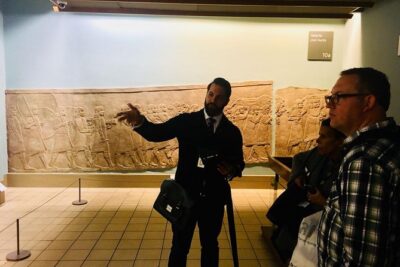
British Museum London Guided Tour Semi-Private 8ppl Max
Read our review →
The British Museum London – Exclusive Guided Museum Tour
Read our review →


Skip the Line: Liverpool Beatles Museum – The perfect tribute to the Beatles
Read our review →Browse the lists this tour appears in