
Reviewed · MUSEUMS
Semi Private Guided tour at British Museum
A morning at the British Museum can feel like speed-walking through time. This semi private guided tour is built to help you pick the best stops, with small groups and a guide who knows exactly how to turn famous objects into understandable stories. You get a focused run through major collections, without losing half your time asking, okay, where is that again?
I like two things most about this experience. First, the guide adds real context fast, including details that make landmarks like the Rosetta Stone and the Parthenon Marbles easier to grasp. Second, the format stays personal, with enough attention to get your questions answered and enough structure to avoid wandering.
One consideration: the British Museum is enormous. Even with a tight plan, you may not cover every room, since the guide adjusts the route to key highlights and your preferences.
In This Review
- Key Reasons to Book
- Why This Semi Private British Museum Tour Feels Like a Tutor Session
- Meeting Point, Museum Rules, and How to Start Smoothly
- Ancient Egypt and the Rosetta Stone, Where the Museum Becomes a Story
- Assyrian and Ancient Greece Highlights, Including the Parthenon Marbles Moment
- Rome, Roman Britain, and the Portland Vase Details That Stick
- Sutton Hoo and Medieval Europe, From Ship Burial to Daily Power
- Aztec and Mayan Collections, Plus Easter Island’s Hoa Hakananai’a
- How Much You Can See in 2.5 Hours, and What You Might Miss
- Price, Value, and Who This Tour Best Fits
- Should You Book This British Museum Guided Tour?
- FAQ
- How long is the British Museum semi private guided tour?
- Where does the tour start?
- Does this tour include museum admission?
- What language is the tour offered in?
- How big is the group?
- Is food or drink included?
- Are gratuities included?
- Is hotel pickup or drop-off included?
- Are there restrictions on luggage or bags?
- Are service animals allowed?
- What is the cancellation policy?
Key Reasons to Book
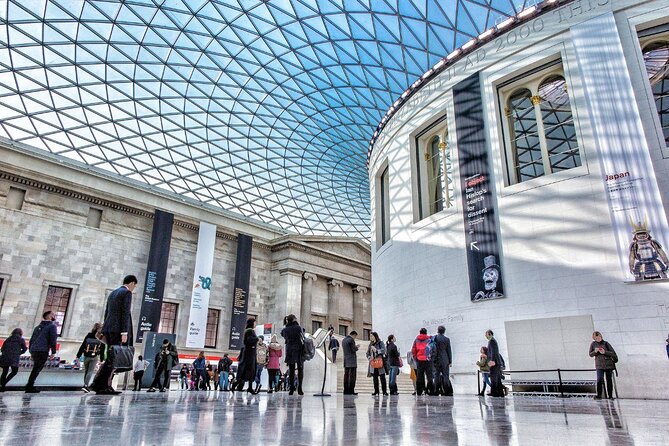
- Small-group size, up to 6 per guide, plus a maximum of 15 travelers total, keeps the experience human
- Major icons in one morning, Rosetta Stone, Parthenon Marbles, and the standout Easter Island head
- A guide who can tailor the route, so you spend time where your interests are
- Smart pacing through a huge museum, including heading to less busy sections when possible
- Multiple world regions in one stop, Ancient Egypt, Assyria, Greece and Rome, plus Aztec and Maya, and Easter Island
Why This Semi Private British Museum Tour Feels Like a Tutor Session
The British Museum is famous, but it can be brutal in practice. You arrive excited, then reality kicks in: galleries are spread out, labels are dense, and it is easy to bounce between highlights without really learning what you are looking at. This semi private format is the fix.
You get a guide who is there to steer your eyes. That matters because the objects themselves are only half the story. When someone explains why the Rosetta Stone mattered, or what makes the Parthenon Marbles so debated and so influential, your brain starts filing the museum correctly. Instead of a grab bag of artifacts, you get a map of themes, time periods, and connections.
I also like that this is not a huge cattle-car group. With a maximum of 6 participants per guide, and an overall cap of 15 travelers, you are more likely to hear answers to your specific questions. In a museum this large, that is the difference between looking at things and understanding them.
Finally, the tour is designed for a morning, not a marathon. In about 2 hours 30 minutes, you should leave with a stronger big-picture feel for what the British Museum does best, from Ancient Egypt to Medieval Europe.
More free halls and paid exhibitions:
Meeting Point, Museum Rules, and How to Start Smoothly
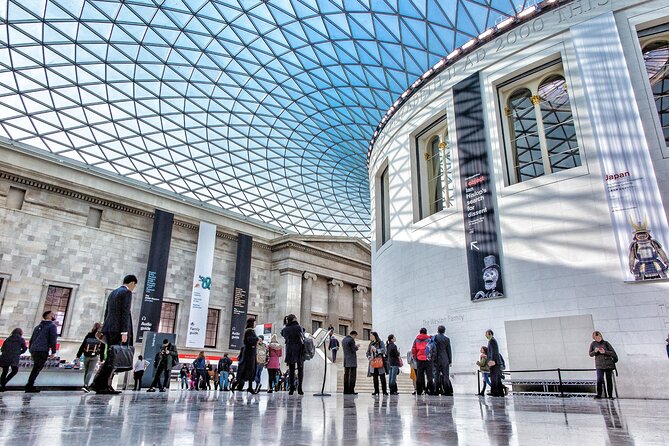
You will meet at 52 Great Russell St, London WC1B 3BA. The tour ends back at the same meeting point, which helps if you plan the rest of your day nearby.
A few practical notes help your morning stay calm. This tour uses a mobile ticket, so have it ready on your phone. The museum does not offer cloakroom services, so if you bring a bulky jacket or large bag, you will need to manage it yourself. Also, bags exceeding 40x40x50 and weighing 8 kilos or more are prohibited from entering, so pack light if you can.
Because there is no hotel pickup, you are responsible for getting yourself to the meeting point. Luckily, the start location is near public transportation, so you should be able to arrive without a big detour.
And yes, kids are welcome, but children must be accompanied by an adult. Service animals are allowed, which is helpful if you travel with one.
Ancient Egypt and the Rosetta Stone, Where the Museum Becomes a Story
The British Museum’s Egyptian collection is a big reason people fall in love with the place. On this tour, you will see headline material like mummies, but also the surrounding context that usually gets skipped when you tour alone.
The lineup can include famous landmarks such as the Rosetta Stone, plus other major Near East and Egyptian objects mentioned for the experience. That matters because the Rosetta Stone is not just a famous name. It is a bridge between languages, administration, and scholarship, and it is much easier to understand when a guide connects it to what you see around it.
You should expect a guided flow that turns Egyptian displays into a narrative arc. You will likely hear about what people believed, how power worked, and why objects were collected and displayed. The guide also helps you notice details you would probably miss, like the difference between purely decorative elements and those tied to ritual or status.
A practical benefit here: Egyptian galleries can swallow your time if you get stuck reading every label. With a guide, you get the key points in a controlled amount of time, so you still have room for the rest of the museum’s “greatest hits.”
Assyrian and Ancient Greece Highlights, Including the Parthenon Marbles Moment
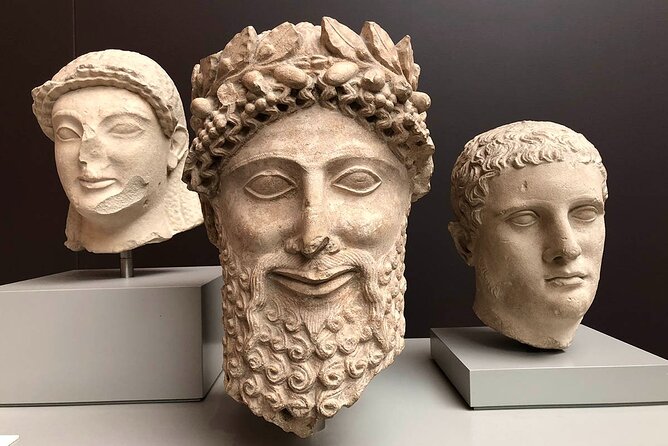
After Egypt, the tour keeps moving through other anchor collections. One of the big draws is the inclusion of major Ancient Greece objects, including the Parthenon Marbles. These sculptures are iconic, and they are also complicated. A guide helps you see beyond the postcard version.
What you gain is perspective. The Parthenon Marbles are tied to how societies represented gods, leaders, and civic identity, and they also connect to later European collecting and display. When you hear that context while standing in front of the sculptures, you can start to understand why people argue about them and why they keep showing up in books, lectures, and museum conversations.
The experience also includes Assyrian highlights. That is a nice balance because Assyrian art often feels more direct and dramatic than you expect. Without guidance, you might focus only on the biggest pieces. With guidance, you learn what to look for in smaller details and why the visuals were designed the way they were.
This is also where the small group format helps. You can ask a question without the whole tour stalling. If you are the type who likes to understand context before you rush to the next room, you will likely enjoy this section.
Rome, Roman Britain, and the Portland Vase Details That Stick
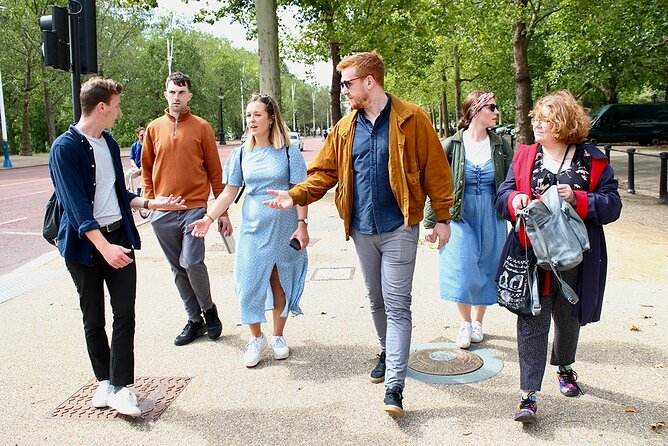
If Greece is about civic identity and idealized forms, Rome is about scale, power, and the everyday show of authority. This tour includes Ancient Rome and Roman Britain, so you are not limited to Rome in theory. You get a sense of Rome’s reach into Britain and how people expressed status across the empire.
One object worth calling out in the tour highlights is the Portland Vase. It is famous in museum circles, and it is the kind of object that rewards slow looking for texture, scene work, and craftsmanship. With a guide, you get help interpreting what the design is doing and why it mattered in its time, not just that it is pretty.
A small caution: at the museum, Rome and Greece can blur together if you do not pin your understanding to something concrete. The guide’s job here is to keep the timeline clear. That means you should leave with at least a basic sense of what is earlier, what is later, and what each culture valued in art.
If you have only one day in London and you want your Roman stop to feel meaningful, this is the right way to do it. You get the big objects and the interpretive glue that helps you remember them later.
Also on in London, no fuss
- Stonehenge, Windsor Castle, and Bath from London★ 4.5 · 18,662 reviews
- London Big Bus Hop-On Hop-Off Tour with Optional River Cruise★ 3.5 · 10,803 reviews
- London Small Group Tour of Historical Pubs★ 5.0 · 10,422 reviews
- Stonehenge, Windsor Castle and Bath with Pub Lunch in Lacock★ 4.5 · 7,402 reviews
Sutton Hoo and Medieval Europe, From Ship Burial to Daily Power
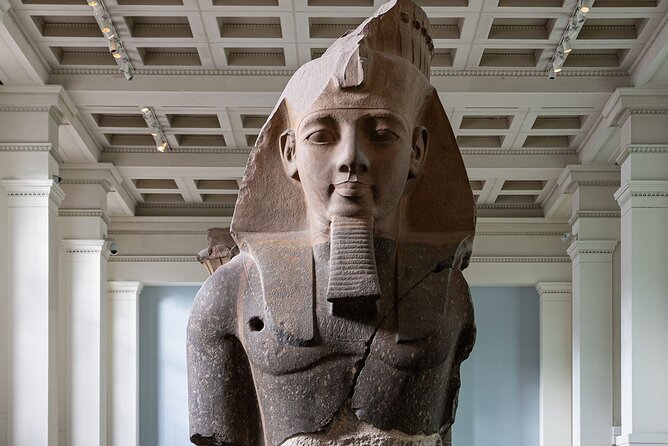
Not every visitor expects to care about Sutton Hoo and Medieval Europe, until they see them. On this tour, you get access to the Sutton Hoo ship burial and a Medieval Europe collection stop. That pairing works well because it shows how Britain’s story changes over time.
Sutton Hoo is the kind of topic that can sound distant until you connect it to real objects, real beliefs, and the way power was displayed. A guided visit helps you understand why the ship burial became such an important piece of evidence, instead of just a headline. It is also a good counterbalance to the more familiar classical material.
Medieval Europe adds another layer. Without guidance, Medieval galleries can feel like a lot of objects that are hard to sort. With a guide, you get a path through it, so your eyes know where to land and your brain knows how to categorize what you are seeing.
A detail mentioned in the tour highlights is the Anglo-Saxon Helmet. If it is included on your route, it is one of those objects that makes you pause because it is so tangible and so specific.
Aztec and Mayan Collections, Plus Easter Island’s Hoa Hakananai’a
One of the smartest parts of this tour is that it refuses to stay locked in Europe and the Mediterranean. You will see an Aztec and Mayan collection, plus an Easter Island head, linked to the Hoa Hakananai’a in the overall tour highlight list.
For many people, this is the emotional payoff of the museum. It stops you from turning the British Museum into a Europe-only stop. It also helps you notice something practical: different cultures created meaning using different visual rules, materials, and contexts.
The Easter Island head is a great example. It is striking in person, but the bigger value is how a guide frames it. You get the sense that this is not an isolated artifact on a pedestal. It has a cultural and island context, and that understanding changes how you view its scale and design.
The Aztec and Mayan stop is similar. You might know the names, but you might not know what to look for in the object choices. A good guide helps you connect themes, symbolism, and historical setting, instead of leaving you with a list of names.
If you want a museum morning that feels like world history, not just a checklist of European classics, this section is why the tour is worth your time.
How Much You Can See in 2.5 Hours, and What You Might Miss
Time is the whole game here. The duration is about 2 hours 30 minutes. That is long enough to cover several major collections, short enough that you are not exhausted by the end.
Still, the museum is too large for anyone to promise you every gallery. The tour explicitly notes that you might not cover every room, and the guide tailors the route around key highlights and your interests. That is realistic, and it is also a good sign. It means you are not trapped in a rigid script.
So what should you do to make this work for you? Decide what you want most in advance. If you care about Ancient Egypt, Greek art, Roman Britain, or the non-European collections, tell your guide what you hope to see. Even a quick mental ranking helps, because you get a tour that can flex.
Also, be ready for a lot of looking. This is not a sit-down lecture. You will spend time in front of objects, and you will be asked to pay attention to details. If you are okay standing and moving at a museum pace, you will get a lot out of it.
If you are the type who needs bathroom breaks every hour, build that into your expectations. In a tight, guided schedule, you cannot wander off for long without cutting into someone else’s time.
Price, Value, and Who This Tour Best Fits
At $142.98 per person, this is not the cheapest way to see the British Museum. But it is also not trying to be. The value is the combination of guided direction, small-group attention, and the fact that admission is listed as free for the tour stop.
Here is the way I think about the price. If you visit solo, you can read labels and follow your instincts. But you pay in time and confusion. This tour pays those costs for you. Your guide helps you prioritize, explains what you are seeing, and keeps you moving efficiently through the museum.
The small-group structure also matters. Maximum 6 participants per guide gives you a reasonable chance of getting personalized answers. If you are the kind of person who likes to ask why something matters, that is where your money goes.
Booking far in advance can also help. The tour is on average booked 73 days in advance, which suggests this format is popular and schedules fill.
Who it suits best:
- You have limited time in London and want a high-impact overview
- You like museum context, not just photos
- You prefer small groups over large guided tours
- You want a mix of cultures, not just one era
Who might prefer something else:
- You want total freedom to roam at your own pace with no structure
- You love reading every label and could spend an entire day in one gallery area
- You travel with heavy luggage that is hard to manage without a cloakroom
Should You Book This British Museum Guided Tour?
If you want a guided British Museum experience that feels focused and personal, I think it is a strong choice. The biggest selling points are the guide-led storytelling for major icons like the Rosetta Stone and the Parthenon Marbles, plus the small-group attention that makes your questions matter.
Book it if your goal is a smart overview in a half-morning, and you want the museum to make more sense as you walk. Skip it if you have the luxury of a full day and you want to go at your own slow reading pace.
If you are deciding based on value, remember this: you are paying for time-saving direction and explanation, not for someone to point out a few famous objects. In a museum this huge, that is what turns a visit from random to memorable.
FAQ
How long is the British Museum semi private guided tour?
It runs for about 2 hours 30 minutes.
Where does the tour start?
The meeting point is 52 Great Russell St, London WC1B 3BA, UK.
Does this tour include museum admission?
Admission is listed as free for the British Museum stop within the tour.
What language is the tour offered in?
The tour is offered in English.
How big is the group?
The tour has a maximum of 6 participants per guide, and a maximum of 15 travelers overall.
Is food or drink included?
No. Food and beverages are not included.
Are gratuities included?
No. Gratuities are not included.
Is hotel pickup or drop-off included?
No. Hotel pickup and drop-off are not included.
Are there restrictions on luggage or bags?
Yes. Bags exceeding 40x40x50 and weighing 8 kilos or more are prohibited from entering. The museum does not offer cloakroom services.
Are service animals allowed?
Yes, service animals are allowed.
What is the cancellation policy?
Free cancellation is available. You can cancel up to 24 hours in advance for a full refund. If you cancel less than 24 hours before the start time, the amount paid is not refunded.
Latest to join the queue for London







Museums, compared.

Tower of London and Crown Jewels Exhibition Ticket
Read our review →

Official tickets: Moco Modern & Contemporary Art Museum
Read our review →
British Museum London Guided Tour Semi-Private 8ppl Max
Read our review →
The British Museum London – Exclusive Guided Museum Tour
Read our review →

Skip the Line: Liverpool Beatles Museum – The perfect tribute to the Beatles
Read our review →Browse the lists this tour appears in