
Reviewed · JACK THE RIPPER & GHOST WALKS
Private Jack the Ripper Walking Tour of Whitechapel and Brick Lane
East London at night tells a dark story. This private Jack the Ripper walking tour threads myths and real-world clues through Whitechapel and Brick Lane, with a 14-inch backlit tablet for on-the-spot visuals and your own guide to steer the pace.
Two things I really like: you get undivided attention in a private format, so questions do not get lost in the shuffle, and the tablet-based photo references help you see people and places while you’re standing where the story unfolded. That matters when you are trying to sort rumor from evidence in such a messy case.
One consideration: plan on a 2.5-hour walk at an evening hour, and there is no bottled water or food provided. Bring your own small bottle, wear shoes that handle uneven streets, and you will be set.
In This Review
- Why This Private Jack the Ripper Walk Feels Different
- Key Highlights That Matter on the Ground
- Entering the East London Streets, Aldgate to the City Boundary
- The Doorway on Goulston Street: Where Physical Clues Get Specific
- Martha Tabram, George Yard Buildings, and the Power of Small Streets
- Brick Lane and the Frying Pan Pub: Last Drinks, Real Neighborhood Flow
- Annie Chapman at Hanbury Street and the Backyard Scene
- Puma Court and the Dear Boss Letter: Turning Paper into Place
- Ten Bells, Mary Kelly, and Christchurch Graveyard: Social Space and Sorrow
- London Fruit & Wool Exchange: From Hell Letter to George Lusk
- Millers Court, Mary Kelly, and How Theories Get Tested
- The Tablet: Why Visuals Make the Case Easier to Follow
- Price and Value: $205.76 for a Private Group Up to 5
- What to Expect From the Guide Experience
- Who This Tour Is Best For (and Who Might Want Another Option)
- Should You Book It?
- FAQ
- How long is the Private Jack the Ripper Walking Tour of Whitechapel and Brick Lane?
- What is the price, and how many people can be in the group?
- Is this tour private or shared?
- What language is the tour offered in?
- Where does the tour start and end?
- What is included in the tour ticket?
- Is food or bottled water provided?
- Is there a minimum age or fitness requirement?
- Are service animals allowed?
- What is the cancellation policy?
Why This Private Jack the Ripper Walk Feels Different
This tour is built for focus. It is not a quick drive-by of famous names. Instead, you move block by block through the East London streets tied to the killings, the letters, and the public panic that followed.
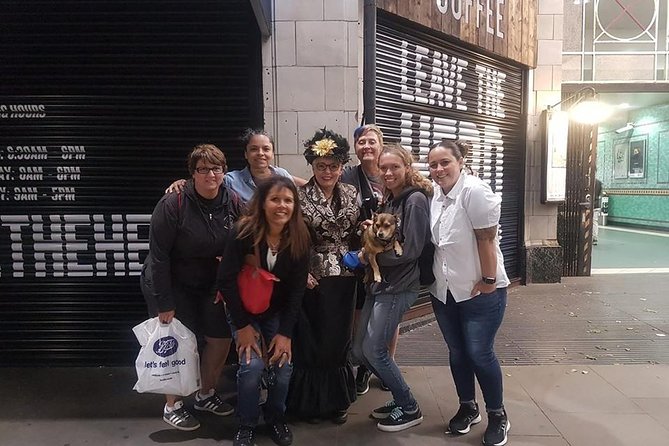
The guide’s style is part of the value. In previous experiences, the host has shown up dressed in Victorian style, like Jenny, and has a way of turning corners into scenes. Even when the subject is grim, the tone stays guided and grounded, with a steady effort to separate what people repeated from what we can actually point to.
Key Highlights That Matter on the Ground
- A private pace for real questions, not a loud group schedule
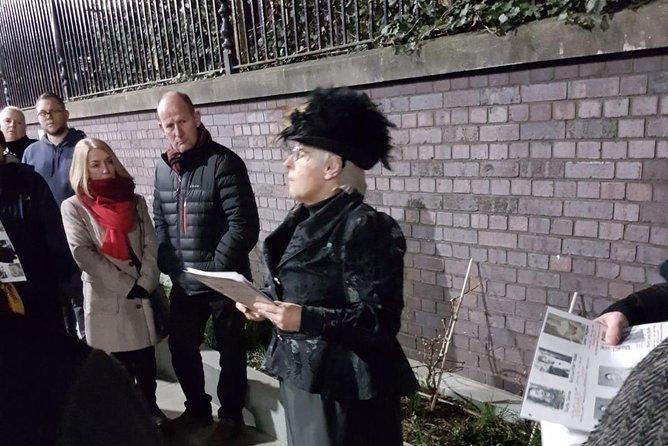
- A 14-inch backlit tablet with photos of victims, sites, and key documents
- Stop-by-stop East London locations, from Aldgate boundary streets to Brick Lane pubs
- Attention to letters and street evidence, like Dear Boss and From Hell
- A long-time local guide feel, including Victorian costuming in some runs
More Ghost Walks in London
Entering the East London Streets, Aldgate to the City Boundary
You start around Aldgate High St, in the East London area that connects old trade routes with the later Whitechapel neighborhoods. Your first real lesson is a simple one: this was not a single uniform London. It was a patchwork of boundaries, workloads, and social pressures.
At St Botolph’s Aldgate, the tour sets the scene for 1888 and the kind of daily life that framed everything. From there, you head to Aldgate Square to talk about poverty and the institutions that housed people who had nowhere else to go, including workhouses and common lodging houses. That context is not fluff. When you understand the living conditions, the later stories about public fear, street gathering places, and vulnerability make more sense.
Then comes the shift into the City of London proper at Mitre Sq. This is where you anchor two of the most discussed murders of the night of September 30, 1888: Elizabeth Stride and Catherine Eddowes. You do not just hear names. You connect the timeline and the geography, so you can picture how events unfolded across neighboring areas.
A quick stop at Petticoat Lane Market follows, and it has a practical, map-level point: this boundary mattered. The tour uses this as a way to explain how the City of London and the broader metropolitan area did not function the same way. If you are the type who likes a clear mental map, you will appreciate how often the walk ties the story to the city layout.
The Doorway on Goulston Street: Where Physical Clues Get Specific
One of the most striking moments on the route is the stop at 118-119 Goulston St. You look at the doorway where a piece of apron linked to Catherine Eddowes was found, along with graffiti on the doorpost.
This kind of stop does two useful things. First, it keeps the tour from floating into pure legend. Second, it teaches you how investigators and observers worked with what they could find at street level, not what people later claimed in hindsight.
In a case like Jack the Ripper, there are lots of competing stories. What you want is training in caution. This doorway stop helps you practice it, because it pulls you back to a tangible, specific location.
Martha Tabram, George Yard Buildings, and the Power of Small Streets

After the Aldgate and boundary segment, the tour drops you into the kind of narrow street logic that makes Whitechapel so hard to “read” from a distance. Here, the story turns to Martha Tabram, described on this route as the first victim now believed to be linked to the case.
You visit Wentworth Street for that introduction, then move to Gunthorpe Street to stand at the street tied to her murder in George Yard Buildings. The value is not just that the names are famous. It’s that the guide keeps the scale realistic: these were enclosed, tightly packed places, and the case mythology often forgets that.
If you are wondering why you should care about the exact street, here is the practical answer. When rumors spread, people tended to repeat stories without walking the terrain. Seeing the geography makes it easier to test which claims could plausibly match what someone could do in such tight areas.
Brick Lane and the Frying Pan Pub: Last Drinks, Real Neighborhood Flow
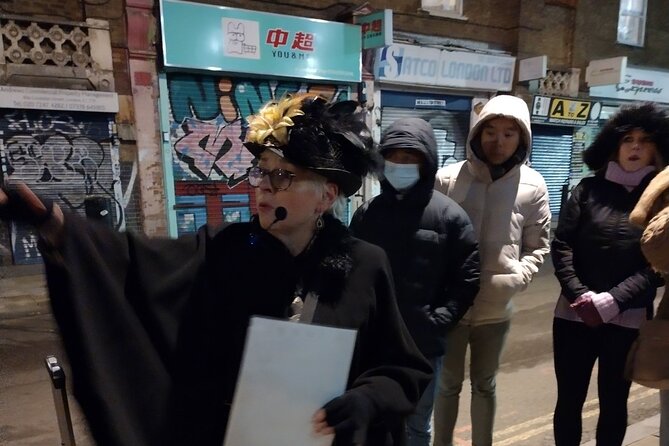
Next is Brick Lane, where you stop opposite the Frying Pan Pub. You are there for a specific detail tied to Mary Anne Nichols, who is also referred to by the nickname Polly in this tour narrative.
This is a smart stop for two reasons. One, pubs were part of daily movement and routine, which helps you picture who might have been around and when. Two, the tour uses the pub location to talk about how the neighborhood functioned, not only how the story ended.
Brick Lane today can feel like a street for shopping and food, but this walk prompts you to look past the modern layer. You are meant to connect the lane’s history to the timeline of the killings, rather than treating it like a generic famous street.
More Guided Walks in London
- Tour for Muggles The Ultimate Harry Potter Walking Tour in London★ 5.0 · 4,684 reviews
- Changing of the Guard Guided Walking Tour in London★ 5.0 · 1,793 reviews
- The Great British Rock and Roll Walking Tour★ 5.0 · 1,371 reviews
- Westminster Guided Walking Tour with Abbey Entry★ 5.0 · 1,282 reviews
Annie Chapman at Hanbury Street and the Backyard Scene
Hanbury Street brings you to a murder site tied to Annie Chapman. The stop is set at the backyard area connected with 29 Hanbury St.
This is where the walk becomes especially vivid in a grounded way. You are not hearing a dramatic retelling. You are viewing a place described in the record and then being asked to hold onto what that setting implies about secrecy, access, and the limits of what a casual passerby would notice.
It also helps explain why people have argued for so long about what happened in these cases. When crimes occur in constrained outdoor spaces, the gap between what people knew and what people assumed can become very wide. This tour keeps pushing you toward that “how could someone have known” thinking.
Puma Court and the Dear Boss Letter: Turning Paper into Place
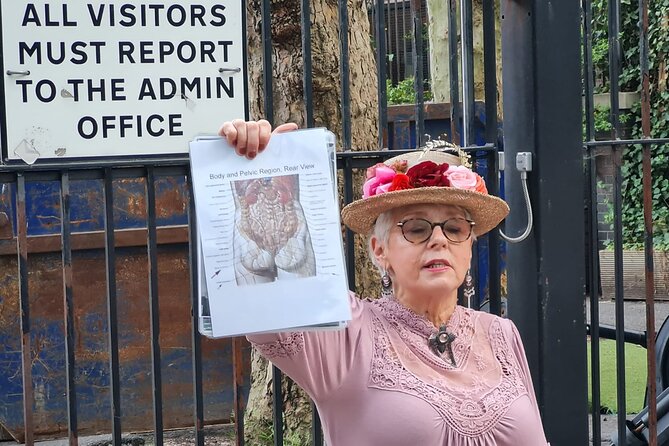
At Puma Court, the tour shifts from street corners to paper. You examine the Dear Boss letter sent to the Central News Office.
This section is valuable because it shows you how the case extended beyond the streets. The letters helped shape public obsession, and public obsession, in turn, fed the myths that grew around the crimes.
The guide’s tablet visuals matter here. When you can see photos of the key documents and compare them to the streets you are standing on, the story becomes less like a legend and more like a network of signals, rumors, and real locations connected by time.
Ten Bells, Mary Kelly, and Christchurch Graveyard: Social Space and Sorrow
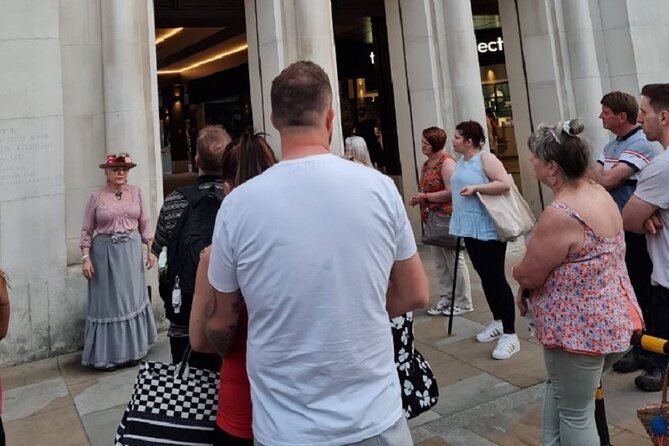
At The Ten Bells, you stop opposite Mary Kelly’s favorite pub and near Christchurch graveyard, where homeless prostitutes were described as gathering during the day.
This stop is one of the clearest examples of why this walk is about more than murders. It treats the area as a human system. You are shown the social anchor points: where people met, where routines formed, and where the community’s pressure points were.
Mary Kelly comes with the story that defines her place in the case’s later timeline. The tour uses that anchor, then surrounds it with the setting that makes the story believable in the way only location can. Even if you have read about Jack the Ripper before, this kind of grounding is often what makes the facts stick.
London Fruit & Wool Exchange: From Hell Letter to George Lusk
Next you head to the London Fruit & Wool Exchange, starting in the passage leading to the central courtyard. Here, you examine the From Hell letter sent to George Lusk of the Whitechapel Vigilance Society.
The tour treats the letter as evidence of how the case widened. A message like this did not stay within a neighborhood. It reached organizations and public-minded figures, and it helped feed the narrative far beyond the immediate crime scenes.
If you like detective work but you prefer it practical, this is a great segment. The guide points you at a specific setting and then connects it to a specific document, so you can see how “the story” became an information event, not just a set of crimes.
Millers Court, Mary Kelly, and How Theories Get Tested
You return to the London Fruit & Wool Exchange courtyard for the final major stop. This is where Millers Court, Dorset St, once stood in the narrative of the last victim, Mary Kelly. You also look at some of the men suspected of the crimes over the years.
This ending has a good balance. It does not pretend the case is solved. It acknowledges that names and theories have circulated for decades, and it invites you to understand why different people made different claims.
That is one of the best reasons to book a private format. You can ask questions at the exact moment something feels confusing. A guide can explain why one theory gained traction, why another did not, and what people tend to overlook when they only read headlines.
The tour ends with a short walk from Liverpool St Station, which makes it easy to continue your evening without getting trapped in a maze.
The Tablet: Why Visuals Make the Case Easier to Follow
A standout feature here is that you get all photos of murder victims, sites, and area references on a 14-inch backlit tablet. This is not just a tech gimmick. It changes how you process the tour.
On a walking tour, your biggest enemy is memory. You see a street, you hear a name, you move on. By the time you stop again, the details can blur.
With a tablet, you can connect the street in front of you to the person or document tied to it. It also helps when you want to keep a few key names straight, especially since the tour includes both victims and letter references tied to wider public reaction.
It also supports the guide’s teaching style. When you can see what the guide is pointing to, you are more likely to catch the nuances between a widely repeated myth and the version that has stronger street-based grounding.
Price and Value: $205.76 for a Private Group Up to 5
The cost is listed as about $205.76 per group for up to 5 people, for roughly 2.5 hours. That means the real math depends on your group size.
For couples, this can work like a premium dinner cost, but you get something more lasting than a meal: a focused guided evening tied to specific places. For families or small friend groups, the private format can be the best value move, because you split the group price and still keep the one-on-one attention.
The private part is not just a comfort perk. On a subject with many names, dates, and competing theories, the ability to ask questions and get quick clarification pays off fast. This tour is built to reward that kind of curiosity.
What to Expect From the Guide Experience
In previous runs, the host has been praised for enthusiasm and for serious research. A guide like Jenny has been described as dressing in Victorian style and using a steady, story-driven approach that stays accurate and clear.
You also get pacing that does not feel rushed. That matters because the route spends a lot of time on small street segments where it would be easy to skim. Here, the timing supports learning.
And because the guide is leading a private group, you are not stuck with a rigid script. If something feels off, you can ask. If a stop triggers a question, you can follow that thread while the context is still fresh in your head.
Who This Tour Is Best For (and Who Might Want Another Option)
This tour fits best if you:
- Like street-level history and want to see the case mapped onto real neighborhoods
- Prefer a guide to manage the chaos of names and theories
- Enjoy the evening atmosphere, since the tour runs in late afternoon and early evening hours
It may be less ideal if you:
- Want a purely light, family-friendly walking pace with no heavy content
- Hate walking on uneven sidewalks for about 2.5 hours at night
The tour lists moderate physical fitness as the requirement and suggests a minimum age of 12+. Service animals are allowed, and it is near public transportation, so you can plan your route without a car.
Should You Book It?
I would book this private Jack the Ripper walk if you want more than a highlights reel. The combination of private pacing, a guide who can answer questions, and a 14-inch backlit tablet with photos and document references gives you a cleaner way to follow a complicated story.
Go for it if your goal is to stand in the actual places connected to the killings and letters, then leave with a sharper sense of what feels plausible, what feels repeated, and what stays uncertain.
If you are looking for a quick, low-effort overview, you might prefer something shorter. But if you want to learn with your feet on the pavement, this one makes the city do the explaining.
FAQ
How long is the Private Jack the Ripper Walking Tour of Whitechapel and Brick Lane?
It lasts about 2 hours 30 minutes.
What is the price, and how many people can be in the group?
The price is $205.76 per group for up to 5 people.
Is this tour private or shared?
This is a private tour. Only your group participates.
What language is the tour offered in?
The tour is offered in English.
Where does the tour start and end?
It starts at Aldgate High St, London EC3N 1AH, UK and ends at Bell Lane, Bell Ln, London E1, UK.
What is included in the tour ticket?
You get photos of murder victims, sites, and the area on a 14-inch backlit tablet for high quality viewing.
Is food or bottled water provided?
No. Bottled water and food or drink are not provided.
Is there a minimum age or fitness requirement?
The tour suggests a minimum age of 12+. It also recommends travelers have a moderate physical fitness level.
Are service animals allowed?
Yes, service animals are allowed.
What is the cancellation policy?
You can cancel for a full refund up to 24 hours in advance of the start time. Cancellation less than 24 hours before start time is not refundable.
On Foot, Brolly Optional
- Walking Tour of London Westminster Abbey, Big Ben, Buckingham
★ 4.5 · 1,213 reviews - London West End Musical Silent Disco Walking Tour Top 1% Rated
★ 5.0 · 1,057 reviews - Westminster 3 Hour Walking Tour and Visit of Churchill War Rooms
★ 5.0 · 967 reviews - WW2 London Walking Tour & Churchill War Rooms Entrance Ticket
★ 4.5 · 933 reviews
Gaslit Lanes
- The Original Jack the Ripper : Guided Tour
★ 5.0 · 1,264 reviews - Ghost Bus Tour of London
★ 4.0 · 961 reviews - Ghastly Ghost Walking Tour in London
★ 5.0 · 878 reviews - Jack the Ripper Walking Tour in London
★ 5.0 · 354 reviews
Latest to join the queue for London


Jack the Ripper & Ghost Walks, compared.
London Jack the Ripper Guided Tour with Ripper-Vision
Read our review →
Ghost, Ghouls and Gallows Tour : Guided Tour with Boat Ride
Read our review →
Ultimate Jack the Ripper : Guided Tour of London
Read our review →
Shadows of York: Ghost Walk and Horrible History.
Read our review →
The Original Jack the Ripper : Guided Tour
Read our review →
Browse the lists this tour appears in