
Reviewed · GUIDED WALKS IN LONDON
Medieval London Walking Tour Oxford PhD Historian Guide
Medieval London walks itself into place. With Dr Geoff, an Oxford PhD historian, you get a medieval history expert lens on the city’s biggest scars and survivals. It’s also a private tour, so you can ask questions without shouting over other groups.
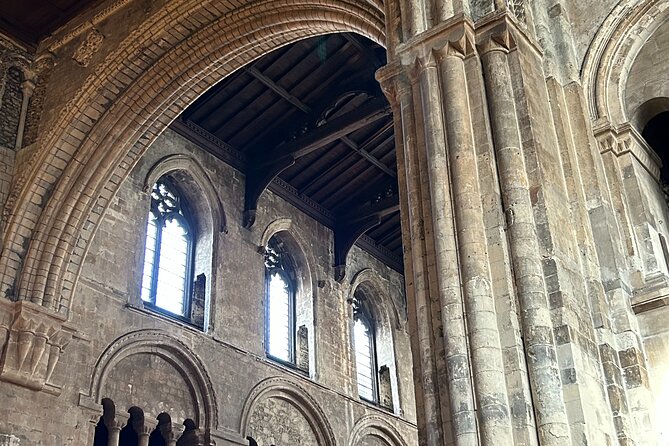
I especially liked how the route uses buildings that lived through massive disruptions. At St Bartholomew the Great, you see 12th-century Norman details still holding up after the Great Fire of 1666, the Reformation, Civil War, and even the Blitz. Then at Temple Church, the story shifts to the Knights Templar and a stone-vaulted interior that endured bombs, while the guide ties in a connection to the Founding Fathers of the United States.
One consideration is that this is a real walking tour, about 2 hours 30 minutes total including the walk between stops. Also, the tour requires good weather, so you should plan around that.
In This Review
- Key highlights to know before you go
- Starting at St Paul’s, where Wren and medieval ruins meet
- William Wallace Memorial stop, a quick pause with national context
- St Bartholomew the Great: Norman arches that survived four big shocks
- Newgate Street and the wall, London’s old entry points
- Temple Church: Knights Templar vaults and a US founding fathers link
- What Dr Geoff brings to the walk, beyond the script
- Timing, walking pace, and what to plan for
- Price and value: $122.18 for a 2.5-hour medieval history focus
- Should you book? My take for the right traveler
- FAQ
- Where does the tour start and end?
- Is there pickup or a meeting-point helper?
- How long is the tour?
- What language is the tour in?
- Are admission tickets included?
- Is this a private tour?
- What if the weather is bad?
Key highlights to know before you go
- Dr Geoff’s Oxford background: he answers architectural and historical questions with real specifics, not vague talking points.
- St Bartholomew the Great included entry: a 12th-century church where key medieval elements survived multiple eras.
- Temple Church included entry: Knights Templar themes plus a stone-vault ceiling that survived wartime bombing.
- Newgate Street and Old Bailey context: you connect medieval city defenses to London’s criminal court history still in use.
- Short, focused stops: quick breaks at key points like the William Wallace Memorial without turning the day into a marathon.
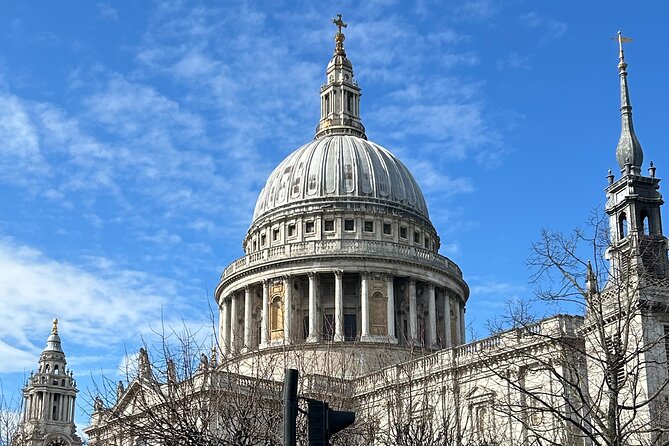
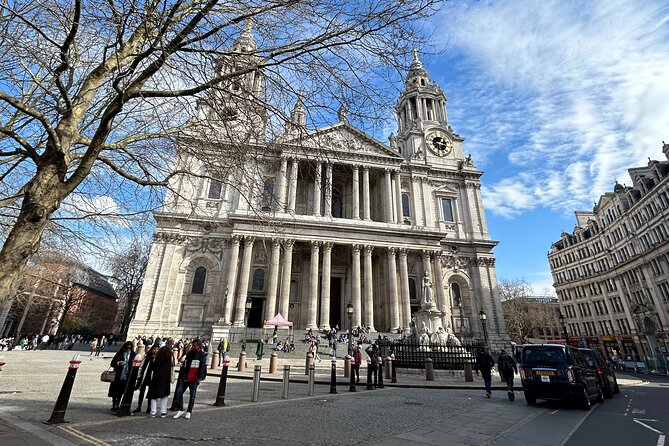
Starting at St Paul’s, where Wren and medieval ruins meet
You begin near the grand stairs outside St Paul’s Cathedral, on the west end of the churchyard. Your guide, Dr Geoff, carries a blue lanyard showing Historic Tours of England, so it’s easy to spot who you’re with.
This first leg matters because St Paul’s is tied to the Great Fire of 1666. The cathedral you see was built by Sir Christopher Wren after the fire destroyed most of medieval London. The tour sets up a clever question right away: if the medieval city was largely wiped out, how do you still find medieval London nearby?
That’s why you’ll learn about Wren and the pre-1666 city context before you even get to the other churches. It’s a smart start, because it changes how you look at what comes next. Instead of treating each stop as an isolated landmark, you start seeing it as part of a longer sequence: medieval life, disaster, rebuilding, and the leftovers that survived close to the chaos.
After St Paul’s, you’ll walk about 18 minutes to St Bart’s (the Church of St Bartholomew the Great area), with Dr Geoff narrating the way so the street scenes stay meaningful.
More Guided Walks in London
William Wallace Memorial stop, a quick pause with national context
Right on the way to St Bart’s, you stop at the William Wallace Memorial. This is a short break, about 10 minutes, and it’s free.
Why include William Wallace on a medieval London walk? It helps widen the story beyond England-only timelines. The memorial points to Scotland’s fight for independence, and Dr Geoff uses that thread to remind you that Britain’s medieval world was bigger than what you see in one county. You get a moment to reset, then you move straight back into London’s physical history.
St Bartholomew the Great: Norman arches that survived four big shocks
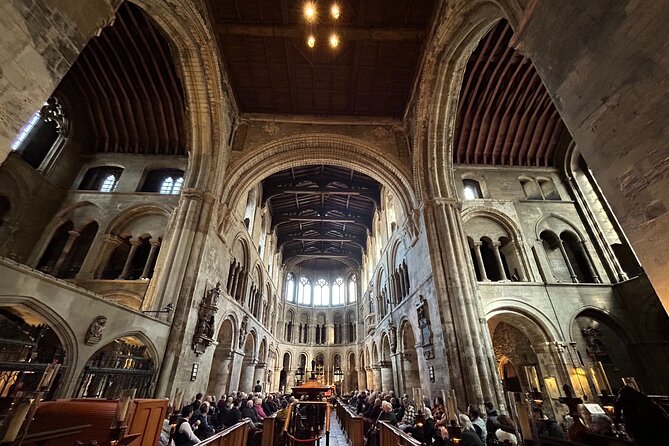
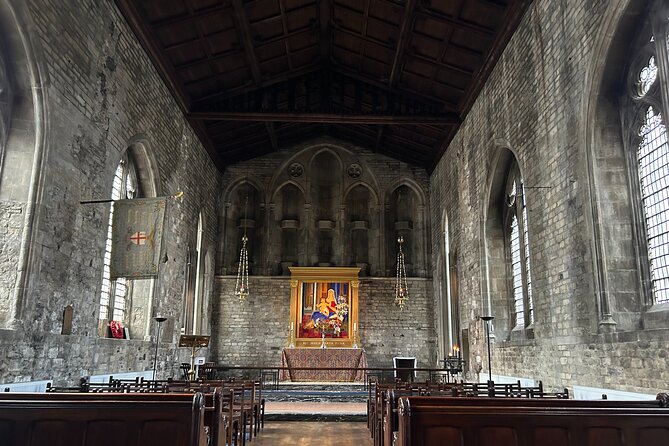
The next stop is Church of St Bartholomew the Great, one of those places that feels like it should have been replaced centuries ago, yet it keeps its medieval skeleton.
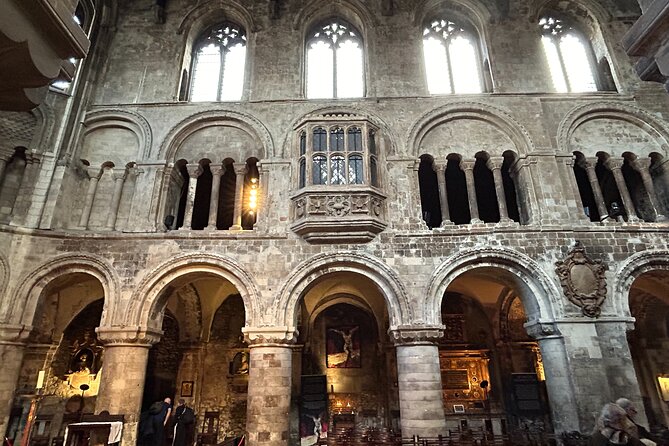
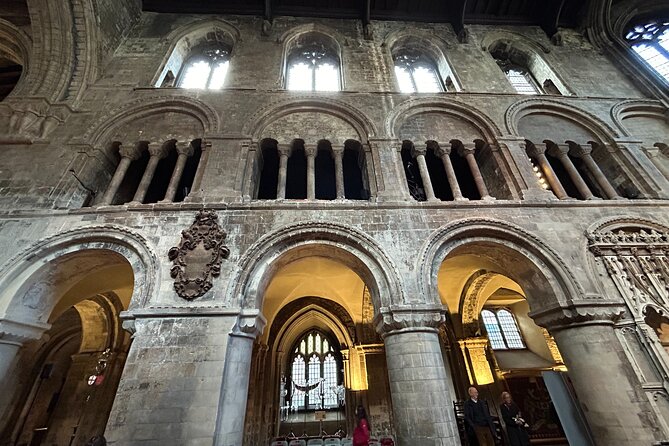
This church is 12th-century, and the early Norman character is a major part of what you’ll notice. Many medieval buildings in London were repeatedly damaged, altered, or rebuilt. Here, though, a lot survived. You’re taught to look for the eastern side features, where you can still see stunning arches, columns, and tombs.
What makes this stop more than just pretty architecture is the survival story. Dr Geoff frames St Bartholomew the Great as a witness to multiple breaks in British history:
- the Great Fire of 1666
- the Reformation
- the Civil War
- and the Blitz in World War II
That sequence gives you a rare chance to understand continuity. You’re not just looking at medieval stonework; you’re watching how one site stayed relevant while the world around it changed.
You’ll also get something practical: Dr Geoff encourages you to compare this early medieval church with later medieval churches on the route. That comparison is where the tour turns from sightseeing into real understanding. Entry is included, and the stop is about 45 minutes, which is long enough to actually absorb details instead of snapping a few photos and moving on.
Newgate Street and the wall, London’s old entry points
From St Bartholomew’s area, you head toward Newgate Street. This portion of the walk is brief, about 10 minutes, and it’s free.
Dr Geoff uses this stop to talk about medieval London’s walls and the city’s entry points. You’re shown Newgate, an old gateway that later became famous as a prison site.
This is one of those stops where the past keeps refusing to stay in the past. Newgate connects forward to London’s criminal justice system: it’s tied to where the Old Bailey (London Criminal Court) was built, and it’s still used today.
If you like when history has consequences, this is your moment. You can walk from medieval defenses to the legal engine that still operates in roughly the same spot, and you start to see London as a city built on layers that keep getting reused.
Temple Church: Knights Templar vaults and a US founding fathers link
Your final major stop is Temple Church, and it’s a highlight for a very specific reason. If you’ve read or seen popular Templar stories, this is where the fiction roots itself in real stone.
Temple Church was built in the 12th century by the Knights Templar, a wealthy and mysterious medieval order of monk-knights. You’re taught how the order fits into the Crusader-era mindset, and then you get to the building itself.
A key detail here is survival through catastrophe and repair. Temple Church survived the Great Fire, but the Victorian restorers did most of the damage. Still, the impressive stone vaulted ceiling survived the Blitz, when bombs rained down all around it.
So you get a rare architectural contrast in one place:
- original medieval vaulting that endured wartime bombing
- later restoration choices that changed the story
Dr Geoff also points out a surprising historical link between Temple Church and the Founding Fathers of the United States. The tour doesn’t treat that as a random fact. It’s used as a bridge, helping you connect how certain British institutions and symbols traveled into the wider modern world.
The Temple Church stop is about 45 minutes, with admission included. You finish in the garden at Temple Church, which gives you a quieter closing space to gather your thoughts before you head off for food.
More England on foot, brolly optional:
- Westminster Guided Walking Tour with Abbey Entry★ 5.0 · 1,282 reviews
- Walking Tour of London Westminster Abbey, Big Ben, Buckingham★ 4.5 · 1,213 reviews
- London West End Musical Silent Disco Walking Tour Top 1% Rated★ 5.0 · 1,057 reviews
- Westminster 3 Hour Walking Tour and Visit of Churchill War Rooms★ 5.0 · 967 reviews
What Dr Geoff brings to the walk, beyond the script
The reviews you’re likely to read for this tour all agree on one thing: Dr Geoff is the reason it feels worth paying for.
This is a private tour, so the format helps. You’re not stuck with a one-way lecture. Dr Geoff has a historian’s structure and an architectural eye. One standout quality is how he connects details to the bigger events, like setting up why Wren matters after the Great Fire, or explaining what you should compare between churches so your observations build instead of becoming random.
You’ll also appreciate the slower pace of understanding. This kind of tour works best when you get to ask follow-ups. Dr Geoff is prepared for them, and he’s happy to answer in a way that stays grounded in what’s visible in front of you.
And yes, the Oxford angle shows up. If you care about why buildings look the way they do, you’ll like how Dr Geoff talks about research and evidence rather than just dates.
Timing, walking pace, and what to plan for
This tour runs with a 10:00 am start. The total duration is about 2 hours 30 minutes, and it includes the walking time from the meeting point all the way to the end point.
Pickup is offered in the sense that Dr Geoff will meet you at the start, identifiable by that blue Historic Tours of England lanyard. You’ll be near public transportation at the start and you end inside Temple Church’s grounds, so you can continue your day without needing to backtrack.
The tour is in English, and most travelers can participate. Service animals are allowed as well.
One big practical note: the experience requires good weather. If it’s canceled due to poor weather, you’re offered a different date or a full refund. In practice, that means it’s smart to book when you’re not counting on one exact hour for a tight schedule.
What should you bring? Stick to basics for a walking tour. Comfortable shoes matter, and if London is doing London, keep a small rain layer handy.
Price and value: $122.18 for a 2.5-hour medieval history focus
At $122.18 per person, this isn’t the cheapest way to see a few churches. The value comes from three things working together.
First, you’re paying for a specialist guide with a serious background (Oxford PhD historian), not a general commentary style. That means you get explanations that help you identify what you’re seeing and why it matters.
Second, the itinerary includes admissions at the two biggest architectural stops:
- St Bartholomew the Great (entry included)
- Temple Church (entry included)
Other parts are short and free, like the William Wallace Memorial and the Newgate Street segment. That blend keeps the walk active without turning every block into a paid entry queue.
Third, you get a concentrated route from St Paul’s to Temple Church that links multiple time periods: post-Great Fire rebuilding, Norman medieval survival, medieval gateways, and Templar-era symbolism. If you tried to do this on your own, you’d likely see the buildings, but you might miss the threads that make them click.
If you’re the type who likes to understand what you’re looking at, the price feels fair. If you just want photos, you’ll probably feel it’s more cost than you needed.
Should you book? My take for the right traveler
Book this tour if you want medieval London that’s practical, specific, and connected. You’ll like it most if:
- you love church architecture and want to know what to look for
- you enjoy story-driven history that stays anchored in real places
- you want a private guide like Dr Geoff who can answer questions as you walk
Skip it, or at least rethink it, if:
- you don’t enjoy walking through a city for a solid chunk of time
- you need a plan that can’t flex with weather
- you prefer self-guided museum time over outside walking and street-level context
If you like your London history with a scholar’s eye and a human voice, this is a strong way to spend half a morning. You finish at Temple Church, looking at stone that has outlasted fire, war, and restoration arguments. That’s the kind of ending that feels earned.
FAQ
Where does the tour start and end?
It starts near the grand stairs at St Paul’s Cathedral, St. Paul’s Churchyard, London EC4M 8AD. It ends in the garden at Temple Church, Temple, London EC4Y 7BB.
Is there pickup or a meeting-point helper?
Pickup is offered. Dr Geoff will meet you at the start and will be wearing a blue lanyard showing Historic Tours of England.
How long is the tour?
The tour is about 2 hours 30 minutes. The total duration includes the walking time from the meeting point to the end point.
What language is the tour in?
The tour is offered in English.
Are admission tickets included?
Yes for two stops. Admission is included for Church of St. Bartholomew the Great and Temple Church. The William Wallace Memorial stop and the Newgate Street stop are listed as free.
Is this a private tour?
Yes. It is a private tour/activity, and only your group participates.
What if the weather is bad?
The experience requires good weather. If it is canceled due to poor weather, you are offered a different date or a full refund. Free cancellation is also available if you cancel at least 24 hours in advance.
Latest to join the queue for London


Guided Walks in London, compared.

Tour for Muggles The Ultimate Harry Potter Walking Tour in London
Read our review →
Changing of the Guard Guided Walking Tour in London
Read our review →
The Great British Rock and Roll Walking Tour
Read our review →
Westminster Guided Walking Tour with Abbey Entry
Read our review →
Walking Tour of London Westminster Abbey, Big Ben, Buckingham
Read our review →
London West End Musical Silent Disco Walking Tour Top 1% Rated
Read our review →
Westminster 3 Hour Walking Tour and Visit of Churchill War Rooms
Read our review →
WW2 London Walking Tour & Churchill War Rooms Entrance Ticket
Read our review →Browse the lists this tour appears in