
Reviewed · MUSEUMS
British Museum Tour with a Qualified Archaeologist Guide
The British Museum can overwhelm you fast. This tour with a qualified archaeologist guide helps you make sense of a museum holding eight million objects, so you actually leave with stories, not just photos.
I love the way the guide connects artifacts to the civilizations that made them. I also love the focus on big names plus less obvious pieces, with stops that hit Rosetta Stone, Pharaoh Ramses II, and the Parthenon Marbles, all in one flowing plan.
One thing to consider: at roughly 2 hours 45 minutes for up to 25 people, the pace is efficient. If you like to linger for long stretches in a single gallery, you may feel a little rushed.
In This Review
- Key points to know before you go
- Starting at Bernard Street, 10:00 am, and using a mobile ticket
- How a qualified archaeologist helps you read the British Museum fast
- From the Rosetta Stone to the Parthenon Marbles: the core highlights in one route
- Assyrian palaces and Greece’s marble stories
- Aztec crown jewels and the Moai mystery
- Lewis Chessmen and the Sutton Hoo hoard of Raedwald
- Is this tour worth it for you?
- FAQ
- How long is the British Museum tour with an archaeologist guide?
- What time does the tour start and where do I meet?
- Where does the tour end?
- Is the tour offered in English?
- Do I need to buy museum admission separately?
- Do I get a ticket after booking?
- How large is the group?
- Are service animals allowed on the tour?
- What is the cancellation policy?
Key points to know before you go
- You get a qualified archaeologist guide, so objects come with context, not just dates.
- A short, efficient route through major highlights like Rosetta Stone and Ramses II.
- You also see less obvious relics, including the Lewis Chessmen and Sutton Hoo items.
- The tour covers far-flung worlds in one walk, from Assyria to Aztec Empire to Easter Island.
- Groups are limited to 25 people, which keeps the experience easier to follow.
- Service animals are welcome, and the meeting point is near public transport.
Starting at Bernard Street, 10:00 am, and using a mobile ticket
This starts at 10:00 am at 10 Bernard St, London WC1N 1LT. You’ll end at the British Museum on Great Russell St, London WC1B 3DG. You also get a mobile ticket, and you should receive confirmation at the time of booking.
That may not sound exciting, but it matters. The British Museum is massive, and the fastest way to waste time is to show up, figure things out, and then stall. This tour is built around getting you moving with your group from the start, instead of spending your first hour just orienting.
The group size is capped at 25 travelers. For a museum visit, that’s a sweet spot. You get structure without feeling like you are in a moving crowd.
More free halls and paid exhibitions:
How a qualified archaeologist helps you read the British Museum fast
The British Museum is famous for a reason, but walking in alone can feel like staring into a fire hose. You see famous artifacts, sure. Then you wonder what you just looked at, why it mattered, and what you missed.
That’s where the archaeologist guide changes your experience. You are not just collecting highlights, you’re learning how archaeologists think. The tour covers the civilizations behind the objects and the questions that still do not have tidy answers. You’ll hear about mysteries that remain mysteries, not because the facts are weak, but because the evidence is incomplete.
In practical terms, you’ll do more than recognize names. You’ll understand how an object fits into a bigger story. When you know what a piece represents, you start noticing the details that casual looking often skips, like the specific choices rulers made in art, or how myths and power show up in material culture.
And based on what people liked most, the biggest win is that you get straight guidance through a museum that can feel cluttered and overwhelming.
From the Rosetta Stone to the Parthenon Marbles: the core highlights in one route
This tour is built like a guided hit list, but it is not a random checklist. You move through the museum with a plan that balances iconic pieces with explanations you can actually use.
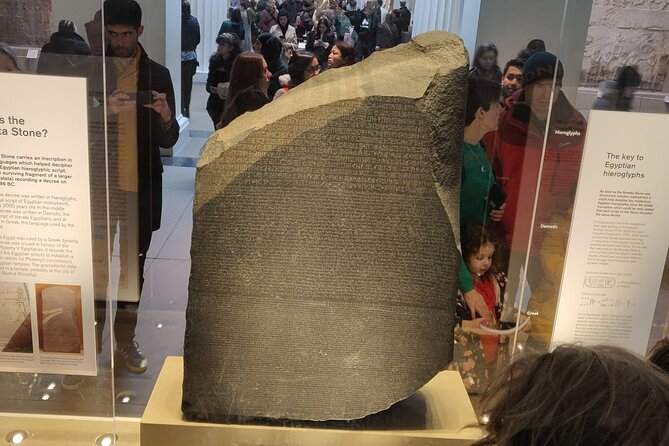
One of the early anchor moments is Ancient Egypt. You’ll cover Rosetta Stone, the item most people know by name, and the tour uses it as a jumping-off point for explaining how scholars connect language, writing, and history. If you have ever looked at an inscription and felt helpless, this kind of guide focus is exactly why you should book. You learn what to look for and why it matters, instead of just staring at stone.
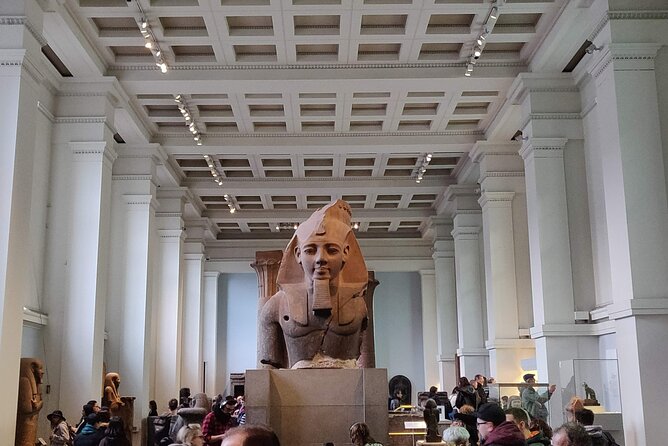
You’ll also see the colossal statue of Pharaoh Ramses II. “Colossal” is literal here, and the scale affects how you interpret the object. A giant figure is not only art, it is messaging. You get a clearer sense of what power looked like in Egypt, and how rulers wanted to be remembered.
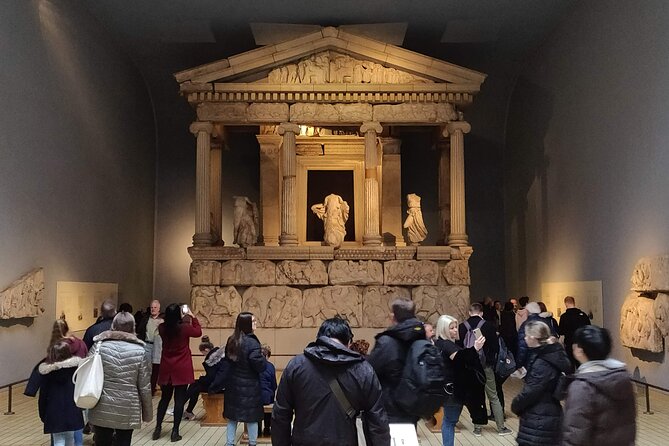
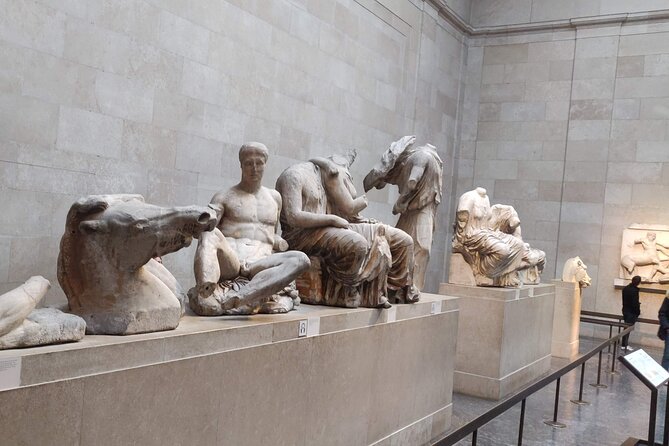
Then the route shifts toward classical Greece, including the Parthenon Marbles. These are some of the most discussed works in the museum, and the value of a guided experience is that you can hold the context in your head while you look. You’ll learn why these marbles are tied to the greatest Greek temples, and how the imagery connects to civic identity and belief.
A small drawback of all this is that you will see a lot in a short time. The trade-off is the guide helps you understand what you are seeing as you go, which is the best kind of museum “time efficiency.”
Assyrian palaces and Greece’s marble stories
Ancient Assyria gets its own spotlight on this tour, including the extraordinary palaces of the brutal rulers of the Assyrian Empire. The word brutal can sound like a headline, but the point is bigger than shock value. Assyrian palace art was political communication. It is meant to show dominance, control, and the consequences of resisting power.
When you have a guide, you start noticing how scenes are constructed to instruct the viewer. Carved narratives, figure scale, repeated motifs, and the feeling of motion all work together. Without context, palace reliefs can look like busy decoration. With context, they start to read like a message sent across centuries.
This is also where you get a more balanced view of empires. Egypt and Greece often get the museum attention, but Assyria is a reminder that ancient power could be structured and displayed in very different ways. The tour makes sure you do not skip that layer.
For many history buffs, this Assyria portion is a highlight because it connects politics to the physical space of palaces. You learn to look beyond the name of an empire and toward how rulers used art to govern the story others would tell about them.
Aztec crown jewels and the Moai mystery
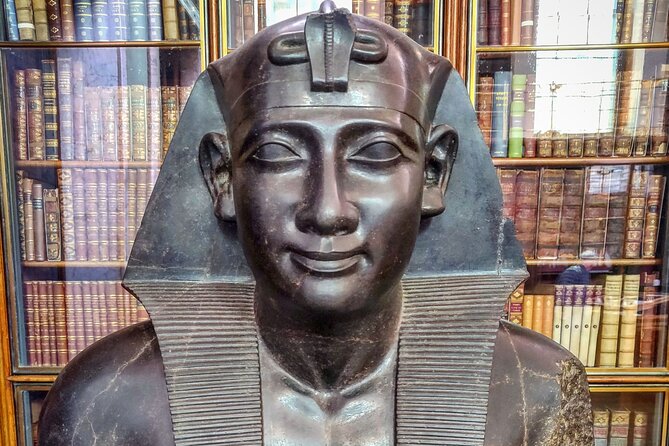
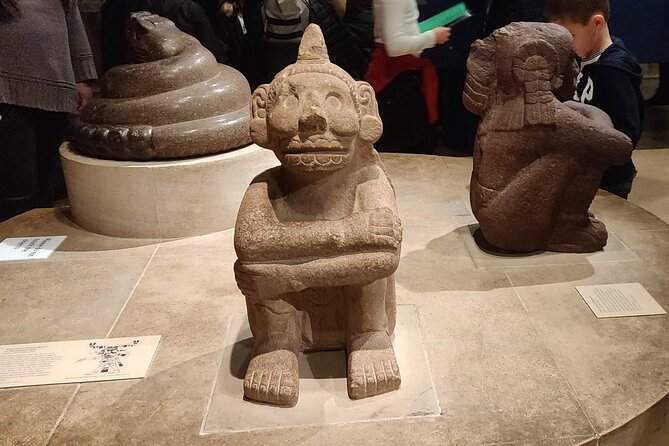
This tour stretches far beyond the Mediterranean. You’ll cover the crown jewels of the Aztec Empire and the secrets of the Moai statues of Easter Island.
I like how this works because it forces a mindset shift. You are not just repeating one regional style or timeline. You are comparing how societies create symbolic authority. Aztec crown jewels relate to status, ritual, and the visual language of leadership. Moai statues, on the other hand, raise questions that feel different in kind. The fascination here is not only what the statues are, but the questions behind how and why they ended up where they did, and what we do not fully know.
That blend matters for you if you tend to read about history in chapters. A museum guide like this turns those chapters into objects you can stand in front of. You come away with a sense that the past is big, complicated, and sometimes frustratingly incomplete, which is exactly why archaeology is interesting.
One more practical point: these topics can pull your attention away from the museum’s size. If you keep getting distracted or overwhelmed, the guide’s theme changes act like reset buttons. You go from Egypt to Assyria to Greece, then across the world, and the movement helps your brain hold onto the highlights.
Also on in London, no fuss
- Stonehenge, Windsor Castle, and Bath from London★ 4.5 · 18,662 reviews
- London Big Bus Hop-On Hop-Off Tour with Optional River Cruise★ 3.5 · 10,803 reviews
- London Small Group Tour of Historical Pubs★ 5.0 · 10,422 reviews
- Stonehenge, Windsor Castle and Bath with Pub Lunch in Lacock★ 4.5 · 7,402 reviews
Lewis Chessmen and the Sutton Hoo hoard of Raedwald
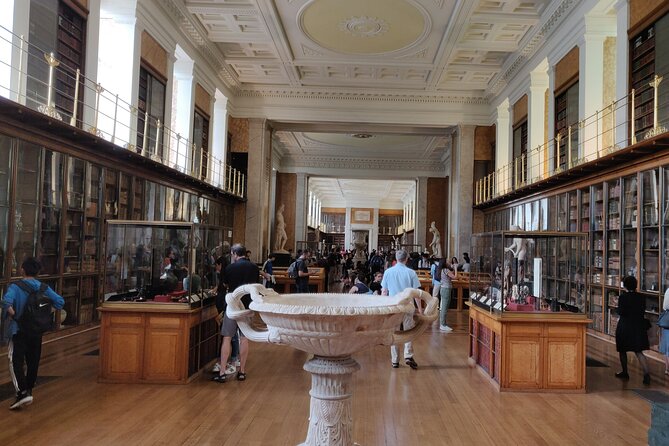
Two of the most memorable inclusions for me are the Lewis Chessmen and the Sutton Hoo hoard, connected to the grave of the mysterious King Raedwald.
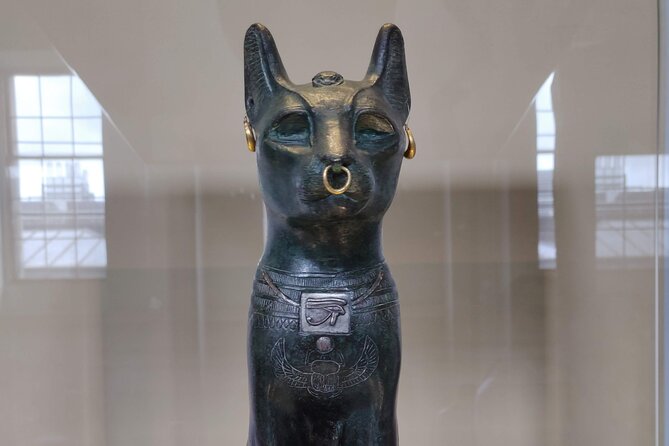
The Lewis Chessmen are described as the most astounding relic to survive from the Viking age. When you see them with context, you understand why they matter beyond being old. They are evidence of leisure, craftsmanship, trade connections, and the kind of everyday culture that often disappears. A guided explanation helps you see that they are not just carved pieces, they are a clue about life.
Then you shift to Sutton Hoo. You’ll discover the hoard from the grave of King Raedwald. This is one of those stories that feels like a history puzzle. The “mysterious” part is part of the appeal, but the guide helps you anchor that mystery in the object evidence.
If you like the romance of old discoveries, this section delivers. If you prefer evidence over legend, it still works, because you can focus on what the items tell you even when you cannot prove every detail. That is archaeology in a nutshell: careful interpretation, honest uncertainty.
At this stage of a 2 hours 45 minutes experience, you might feel museum-fatigued. But this is where the tour’s structure pays off. You’ve already built context, so the final hits land harder.
Is this tour worth it for you?
I think this tour is a strong pick if you care about history and want a museum visit that feels guided, not chaotic. It is also ideal for locals and tourists alike because it turns the British Museum into a planned route through major themes, instead of an endless self-guided wandering session.
You’ll likely enjoy it most if:
- you like learning about civilizations behind the artifacts, not only the artifacts themselves
- you want to cover a lot without spending energy figuring out where to go next
- you are a solo attendee and want a group structure that makes it easier to participate comfortably
- you need an experience that welcomes service animals
The main trade-off is the time limit. You will not see everything. With a compact tour window, the goal is clarity over exhaustion. If your dream is to spend hours studying one artifact at a time, a self-guided plan might suit you better. But if your goal is to leave with a smart map of the museum and a story for what you saw, this format is built for you.
Also, the tour includes an admission ticket marked as free. That is real value, because museum entry adds up and it keeps the experience simpler: you are focusing on the tour content, not extra ticket math.
FAQ
How long is the British Museum tour with an archaeologist guide?
It runs for about 2 hours 45 minutes (approximately), with the activity time listed as 2 hours 30 minutes.
What time does the tour start and where do I meet?
The start time is 10:00 am. You meet at 10 Bernard St, London WC1N 1LT, UK.
Where does the tour end?
The tour ends at The British Museum on Great Russell St, London WC1B 3DG, UK.
Is the tour offered in English?
Yes, it is offered in English.
Do I need to buy museum admission separately?
The information provided lists an admission ticket as free, so you are not expected to purchase museum entry separately for this activity.
Do I get a ticket after booking?
Yes, you receive a mobile ticket. You should also receive confirmation at the time of booking.
How large is the group?
The tour has a maximum of 25 travelers.
Are service animals allowed on the tour?
Yes, service animals are very welcome.
What is the cancellation policy?
Free cancellation is available. You can cancel up to 24 hours in advance for a full refund, and changes within 24 hours do not get refunded.
Should I book this tour or not?
If you want a British Museum visit that turns famous artifacts into understandable stories, I’d book it. If you are chasing maximum time per gallery or a fully independent pacing style, consider self-guided time instead. This tour is best when you want focus, context, and a smart route through the museum’s biggest names plus a few smart surprises.
Latest to join the queue for London





Museums, compared.

Tower of London and Crown Jewels Exhibition Ticket
Read our review →

Official tickets: Moco Modern & Contemporary Art Museum
Read our review →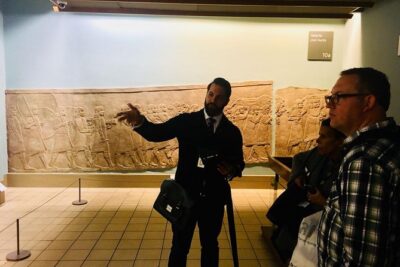
British Museum London Guided Tour Semi-Private 8ppl Max
Read our review →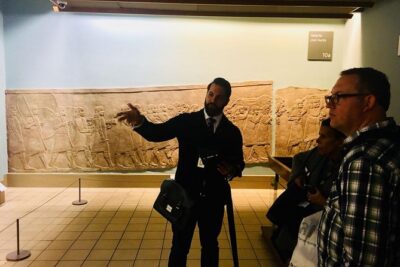
The British Museum London – Exclusive Guided Museum Tour
Read our review →


Skip the Line: Liverpool Beatles Museum – The perfect tribute to the Beatles
Read our review →Browse the lists this tour appears in